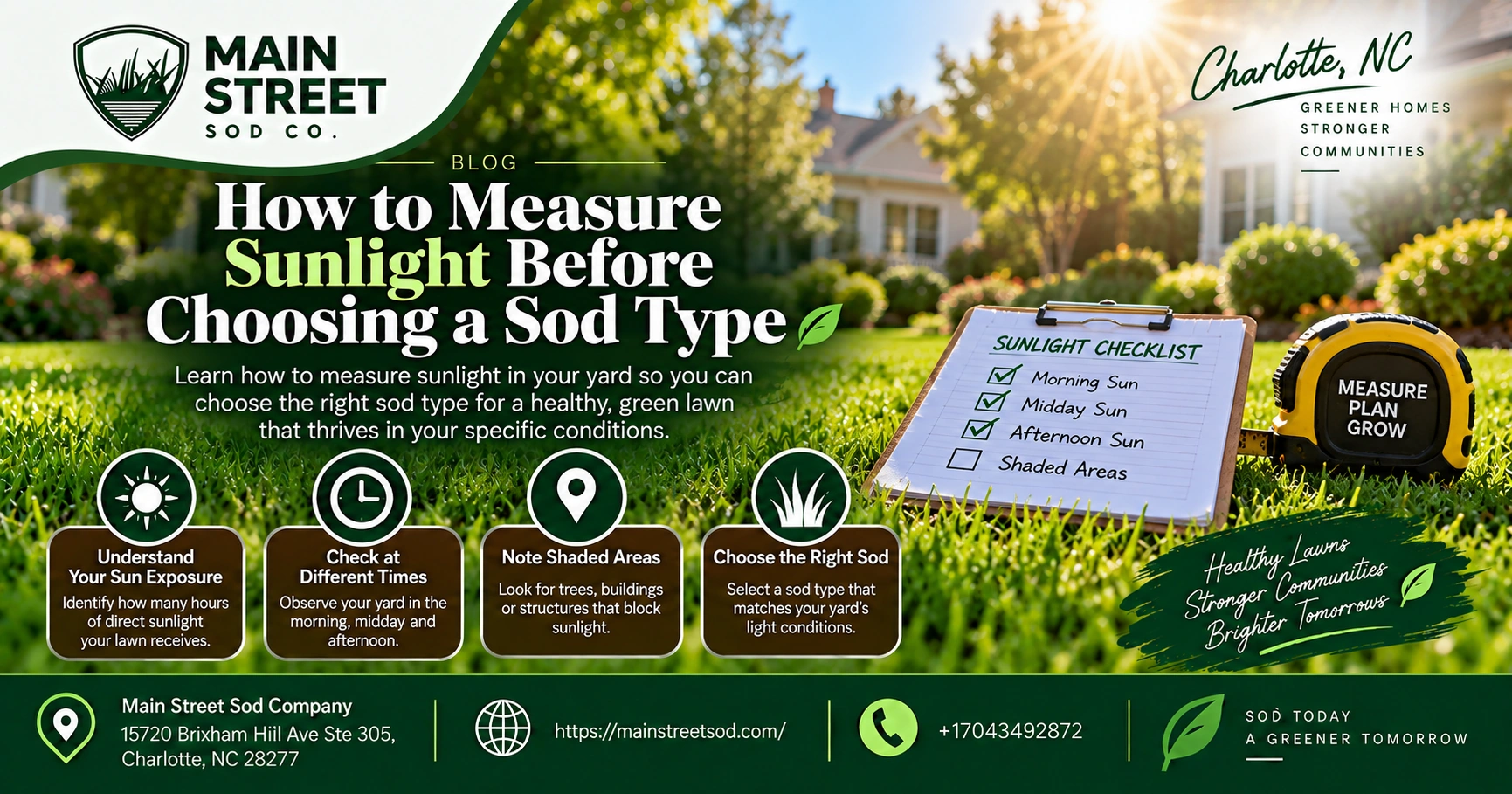
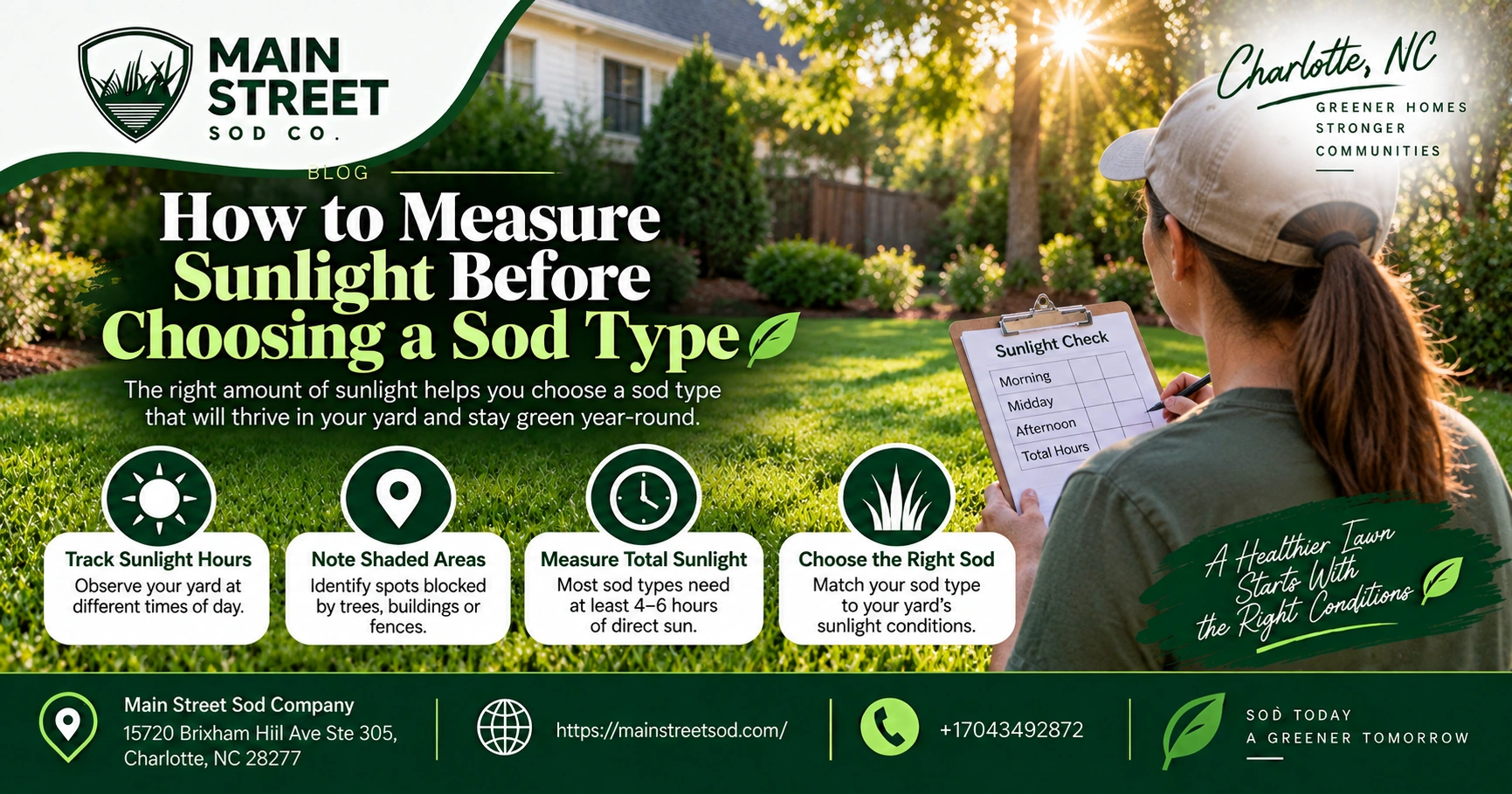
Before choosing grass based on color, texture, or appearance, spend a day finding out how much sunlight your lawn actually receives.
Homeowners who measure sunlight before choosing sod can narrow down turf options based on real growing conditions instead of guessing whether a yard is “sunny” or “shady.” The important measurement is not how bright the yard looks. It is how many hours of useful direct sunlight different sections receive throughout the day.
A front lawn may get strong morning sun while the backyard stays shaded by trees. One side of the house may receive several hours of afternoon light while another gets almost none. Those differences can affect which grass performs well.
You do not need specialized equipment to get a useful first assessment. A phone, a few notes, and several observations throughout the day can give you a much clearer picture of the lawn before you choose sod.
Why Does Sun Exposure Matter When Choosing Sod?
Grass needs light to produce the energy required for healthy growth.
Different turf types and varieties handle shade differently. Some perform best in strong, open sunlight, while others provide more flexibility where portions of the lawn receive filtered or partial shade.
That means a grass can be perfectly suited to your regional climate and still struggle if it is installed in the wrong part of the property.
For example, two yards on the same street may have very different turf needs.
One property may have:
- An open front yard
- Few mature trees
- Strong sunlight for most of the day
- Minimal shade from buildings
The neighboring property may have:
- Large established trees
- A two-story house casting afternoon shade
- A fenced backyard
- Several areas receiving only limited direct sun
Choosing exactly the same turf for both properties without considering light conditions can produce very different results.
Sunlight affects more than color
Insufficient light can contribute to turf becoming thinner and less vigorous.
A struggling shaded lawn may also be less capable of recovering from ordinary wear because the grass is already growing under less-than-ideal conditions.
Adding fertilizer or increasing irrigation will not create additional sunlight. If the site is too shaded for the selected grass, maintenance alone may not solve the underlying problem.
That is why sunlight should be evaluated before turf selection rather than after new sod begins struggling.
What Is the Difference Between Full Sun and Partial Shade?
Terms such as full sun, partial sun, and partial shade are useful, but homeowners should not treat them as perfectly universal turf measurements.
Grass varieties differ, and sunlight intensity also changes with location, season, tree canopy, and time of day.
Instead of relying only on labels, focus first on what is physically happening in your yard.
Full-sun areas
A full-sun section of lawn receives direct sunlight for a substantial portion of the day with few interruptions from buildings or trees.
These are often:
- Open front lawns
- Large backyards with few trees
- Areas away from tall structures
- South- or west-exposed portions of some properties
Full-sun sites generally give homeowners more flexibility when considering turf varieties that perform best in strong light.
Partial-sun areas
Partial-sun areas receive direct sunlight for part of the day and shade for the rest.
For example, grass might receive strong sunlight from morning through early afternoon before the house shades it later.
The timing matters.
Several hours of strong direct light can create a much different environment from a spot that receives only brief patches of light passing through a tree canopy.
Partially shaded areas
A partially shaded lawn receives less direct light, often because of:
- Mature trees
- The house
- Garages or sheds
- Fences
- Neighboring structures
- Dense landscaping
Some turf options handle these conditions better than others, but “shade tolerant” should not be interpreted as “no sunlight required.”
Deep shade
Deep shade is where turf selection becomes much more difficult.
Areas that receive little meaningful direct sunlight throughout the day may not support dense grass reliably, regardless of how much effort goes into maintenance.
Before repeatedly replacing turf in a deeply shaded location, consider whether grass is actually the right ground cover for that part of the property.
How Do You Measure Sunlight in Your Yard?
The simplest way to measure lawn sunlight is to observe the property at regular intervals throughout a clear or mostly clear day.
You are looking for direct sunlight, not simply whether the yard appears bright.
Start in the morning
Begin shortly after the sun is high enough to reach the property.
Walk through the yard and note which areas are receiving direct sun and which are shaded.
You can divide the property into basic zones such as:
- Front lawn
- Left side yard
- Right side yard
- Back lawn near the house
- Back lawn near the property line
- Areas beneath large trees
You do not need a professional property map. A simple sketch works.
Check every one to two hours
Return to the same areas throughout the day.
For each section, mark whether it is:
- In direct sunlight
- Receiving filtered sunlight
- Mostly shaded
- Completely shaded
Checking at roughly one- or two-hour intervals is usually enough for a practical homeowner assessment.
If you want greater accuracy, check more frequently.
Record the approximate total
At the end of the day, estimate how many hours of direct sun each lawn zone received.
For example:
| Lawn Area | Morning | Midday | Afternoon | Approximate Direct Sun |
| Front yard | Sun | Sun | Sun | High |
| Left side | Shade | Sun | Shade | Moderate |
| Under oak tree | Filtered | Filtered | Shade | Low |
| Back patio area | Shade | Sun | Sun | Moderate to high |
You do not need to reduce every section to a perfect number.
The goal is to distinguish clearly sunny areas from mixed-light and heavily shaded areas.
Take photos
Phone photos are extremely useful.
Take pictures from approximately the same location in the morning, around midday, and later in the afternoon.
When you compare them afterward, it becomes much easier to see how shadows move across the property.
Photos can also be useful if you later ask a sod professional for recommendations.
Pay attention to filtered light
A lawn beneath tree branches may appear bright because light is coming through the canopy.
That is not necessarily equivalent to several hours of unobstructed direct sun.
Note areas that receive mostly dappled or filtered light separately from open full-sun locations.
Repeat the observation if necessary
One unusual day does not always represent typical conditions.
If cloud cover, temporary obstacles, or other factors make the results unclear, repeat your observations on another suitable day.
A second check can be especially helpful when you are deciding between turf options with meaningfully different shade tolerances.
How Do You Match Grass Types to Sun Exposure?
Once you have divided the lawn into sunlight zones, use those observations to eliminate grass types poorly matched to the property.
Do not start by asking, “Which grass looks best?”
Start with:
Which grasses can realistically perform in the amount of sunlight my yard receives?
For predominantly sunny lawns
Properties with strong direct sunlight across most of the lawn generally have greater flexibility among sun-loving turf types.
Main Street Sod’s turf selection includes Bermuda varieties alongside other options. Bermuda is commonly considered where strong sunlight and warm-season performance are priorities.
The exact variety should still be chosen based on more than light alone.
For lawns with mixed sun and shade
A lawn with open sunny sections and areas of partial shade requires more consideration.
Zoysia options can be worth comparing where some additional shade flexibility is needed, while Fescue may also be considered for appropriate properties and conditions.
However, the specific amount of light still matters.
Do not choose a turf simply because it carries a general reputation for “shade tolerance.” Match the actual variety to your site’s conditions.
For heavily shaded lawns
If large portions of the property receive little direct sunlight, turf choices become more limited.
In deep shade, even relatively shade-tolerant grass can remain thin.
This is particularly common:
- Beneath mature tree canopies
- On narrow sides of homes
- Between buildings
- Along tall privacy fences
- On lawns surrounded by dense woods
Where light is severely limited, consider whether that section should remain turf at all.
Sunlight is only one selection factor
Once you know which grasses fit the lawn’s light conditions, consider the other factors.
These may include:
- Regional climate
- Summer heat
- Winter temperatures
- Soil
- Drainage
- Irrigation
- Pet traffic
- Children and lawn use
- Maintenance preferences
- Desired appearance
Main Street Sod’s guide to choosing sod for your climate can help with the climate side of that decision after you have assessed sunlight.
Think of sunlight measurement as the first filter. Climate, soil, traffic, and maintenance can then narrow your choices further.
What Are Common Sunlight Measurement Mistakes?
Homeowners often know whether their yard feels sunny or shady, but that impression is not always accurate enough for turf selection.
Avoid these common mistakes.
Checking the yard only once
Looking outside at noon tells you what happens at noon.
It does not tell you whether the same area was shaded all morning or will disappear into shade an hour later.
Sunlight needs to be observed across the day.
Assuming a bright area receives direct sun
A bright yard can still be receiving mostly indirect or filtered light.
Look for whether direct sunlight is actually reaching the turf.
Ignoring trees
Trees create changing shade patterns.
A lawn may receive direct sun early and then spend most of the afternoon beneath a canopy.
Pay particular attention to mature trees close to areas where sod will be installed.
Ignoring buildings and fences
The house itself may be one of the largest shade sources on the property.
Garages, neighboring homes, privacy fences, sheds, and other structures can also block sunlight for long periods.
Track structural shade just as carefully as tree shade.
Measuring only one part of the yard
A property rarely has identical light everywhere.
Do not measure the sunny front lawn and assume the result applies to a shaded backyard.
Break the lawn into separate zones.
Forgetting seasonal changes
The sun’s path and day length change throughout the year.
Deciduous trees also create much heavier shade when they are fully leafed out than when branches are bare.
If you measure a tree-covered yard when leaves are absent, remember that growing-season sunlight may be significantly different.
Likewise, shadows from buildings can change position and length throughout the year.
You do not necessarily need to monitor the property for twelve months. You do need to think about whether the conditions you are seeing represent the period when the grass will be actively growing.
Treating shade tolerance as a guarantee
A grass described as having better shade tolerance still needs sufficient light.
Shade tolerance means relative flexibility not the ability to thrive in darkness.
If a location receives almost no direct or useful filtered light, changing grass types may not solve the problem.
When Should You Get Help Choosing a Sod Type?
Many homeowners can perform the sunlight assessment themselves.
Professional input becomes more useful when the conditions are mixed or when choosing incorrectly could mean replacing a substantial amount of turf.
Consider asking for help when:
- Different parts of the lawn receive dramatically different amounts of sun
- Mature trees shade a large percentage of the property
- You are deciding between several turf varieties
- Previous grass repeatedly failed in shaded areas
- You are unsure whether the yard receives enough useful light
- Soil or drainage problems are also present
- The property crosses several distinct growing conditions
- You are planning a large sod project
Bring your observations with you.
Photos taken throughout the day and notes about direct sunlight can help make the conversation much more useful than simply describing the lawn as “kind of shady.”
Homeowners throughout Main Street Sod’s service areas can compare available turf options based on the actual conditions of their property.
At Main Street Sod, the goal is to match turf to the yard rather than choosing a grass first and hoping the site conditions work.
Measure First, Then Choose Your Sod
Choosing the right turf gets much easier once you know how much sunlight the lawn really receives.
Spend a clear day checking different parts of the property every hour or two. Record direct sunlight, filtered light, and shade, and take photos as the shadows change.
Then separate the lawn into three broad categories:
- Predominantly sunny
- Mixed sun and partial shade
- Heavily shaded
Use those observations to narrow down your sod and turf options before comparing climate suitability, appearance, traffic tolerance, maintenance, and other factors.
A few hours of observation before ordering sod can reveal growing conditions that may otherwise become obvious only after the new lawn is already installed.
FAQs
How do I measure sunlight before choosing sod?
Check each part of the lawn at regular intervals throughout a clear day and record whether it receives direct sun, filtered light, or shade. Repeat the observations from morning through late afternoon, then estimate the amount of direct sunlight each section receives.
Should I measure direct sunlight or general daylight?
Focus primarily on direct sunlight while also noting filtered or dappled light beneath trees. A lawn can look bright without receiving the same light intensity as an open, sunny area.
Can different parts of one lawn need different grass?
Potentially, but mixing turf types is not always the most practical or visually consistent solution. First determine how different the growing conditions really are, then compare turf varieties that can accommodate as much of the property as possible.
Does morning sun count when choosing grass?
Yes. Direct morning sunlight contributes to the total light the lawn receives. The timing and intensity of sunlight can vary, so record all periods of direct exposure rather than measuring only afternoon sun.
How do trees affect sunlight measurements?
Tree canopies create filtered and moving shade that can change throughout the day and by season. Measure the area while trees are leafed out when possible if that better represents conditions during the grass’s active growing period.
What if part of my yard receives almost no direct sunlight?
Very deep shade can make maintaining dense turf difficult, even with grasses that offer better shade tolerance. If an area receives very little usable light, consider getting professional advice before repeatedly installing sod there.