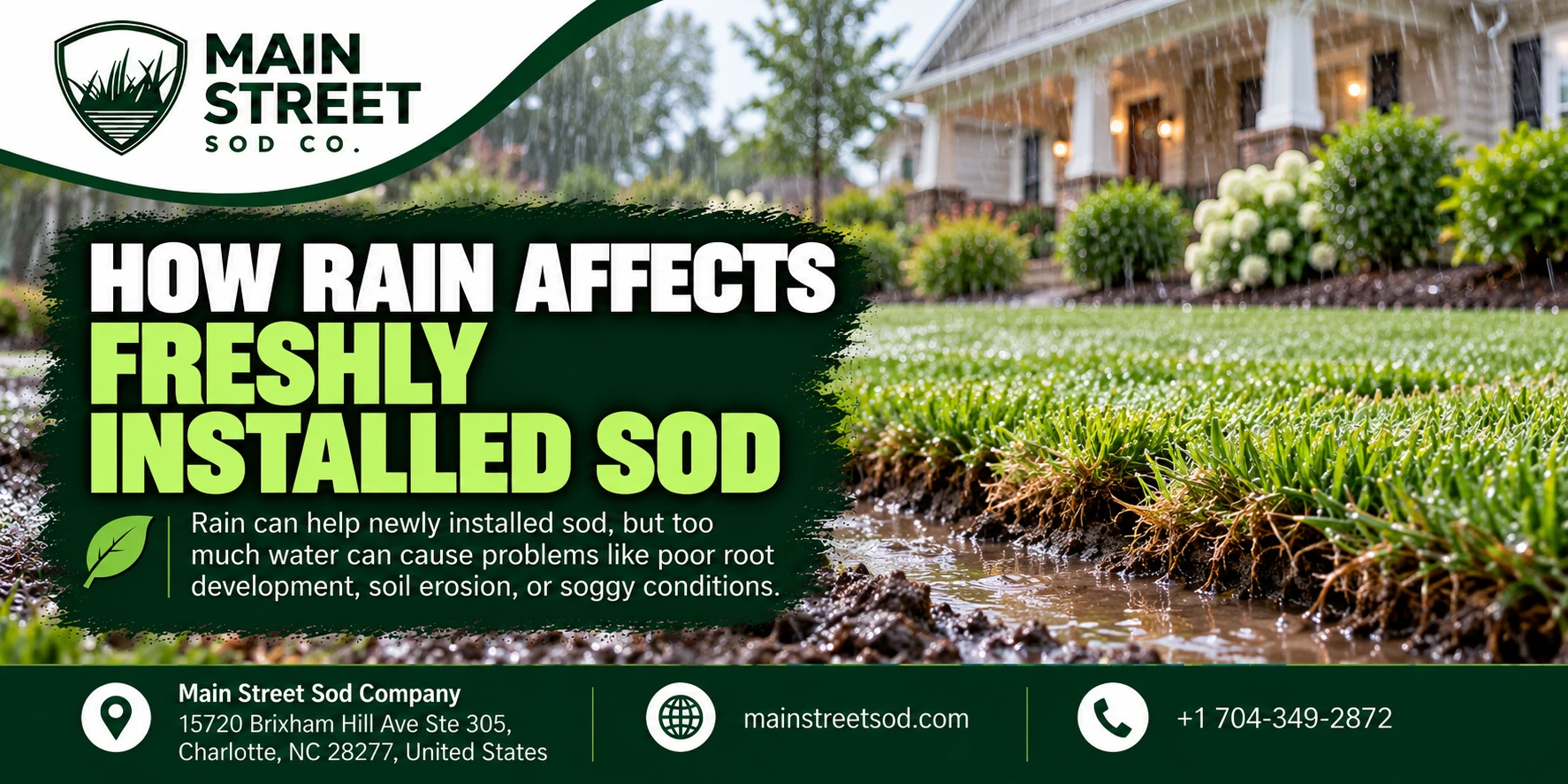
Rain can be helpful for freshly installed sod because new turf needs consistent moisture while roots begin growing into the soil underneath. A soaking rain may reduce or temporarily eliminate the need for supplemental irrigation.
But more rain is not always better.
Heavy rainfall can leave the soil saturated, create standing water, move loosely rooted pieces, erode soil on slopes, or expose grading and drainage problems that were not obvious during dry weather. Fresh sod is particularly vulnerable because its roots have not yet firmly anchored the turf to the ground.
After rain, do not automatically run the sprinklers on their normal schedule. Check the sod and the soil underneath first. If the root zone is already adequately moist, additional irrigation may create unnecessarily wet conditions.
The goal is to maintain enough moisture for establishment without allowing the lawn to remain waterlogged.
For homeowners planning a new lawn, Main Street Sod’s sod installation services include site preparation and establishment considerations that influence how a lawn handles both irrigation and rainfall.
Is Rain Good for Freshly Installed Sod?
Usually, yes when the amount and intensity are appropriate.
Fresh sod needs regular moisture because the root system is still shallow. Rain can supply some or all of that moisture naturally.
Penn State Extension specifically recommends reducing irrigation during rainy periods rather than continuing to water on the same schedule regardless of weather. It also advises keeping newly established turf moist without leaving the soil excessively wet.
Rain can be especially useful when it:
- Falls gradually instead of all at once
- Moistens both the sod and the soil underneath
- Does not produce runoff
- Does not leave prolonged standing water
- Reaches the entire lawn relatively evenly
A light shower may not provide enough water to penetrate the sod layer and wet the soil beneath it.
A steady soaking rain may provide considerably more useful moisture.
That is why the question should not simply be, “Did it rain?”
The better question is, “How wet is the soil underneath the sod now?”
How Much Rain Is Helpful for New Sod?
There is no single rainfall amount that is ideal for every newly sodded lawn.
The useful amount depends on soil type, temperature, drainage, slope, wind, shade, how recently the sod was installed, and how much moisture was already present.
The objective is for the sod and upper soil to stay moist during early establishment without remaining saturated.
Iowa State Extension recommends keeping newly laid sod and the upper soil moist during the first stage of establishment, then gradually transitioning to deeper and less frequent watering as roots develop. It also cautions against saturation because constantly wet conditions can interfere with rooting.
Instead of judging rainfall from the weather app alone, inspect the lawn.
Gently lift a corner of an unrooted piece in a representative area. The soil underneath should feel moist.
If the rain only wet the grass blades while the soil below remains relatively dry, supplemental irrigation may still be needed.
If the underlying soil is thoroughly moist or soggy, additional watering should wait.
A rain gauge can also help homeowners understand how much precipitation actually reached the property.
Can Heavy Rain Damage Fresh Sod?
Yes.
Heavy rain presents different risks than a gentle soaking shower.
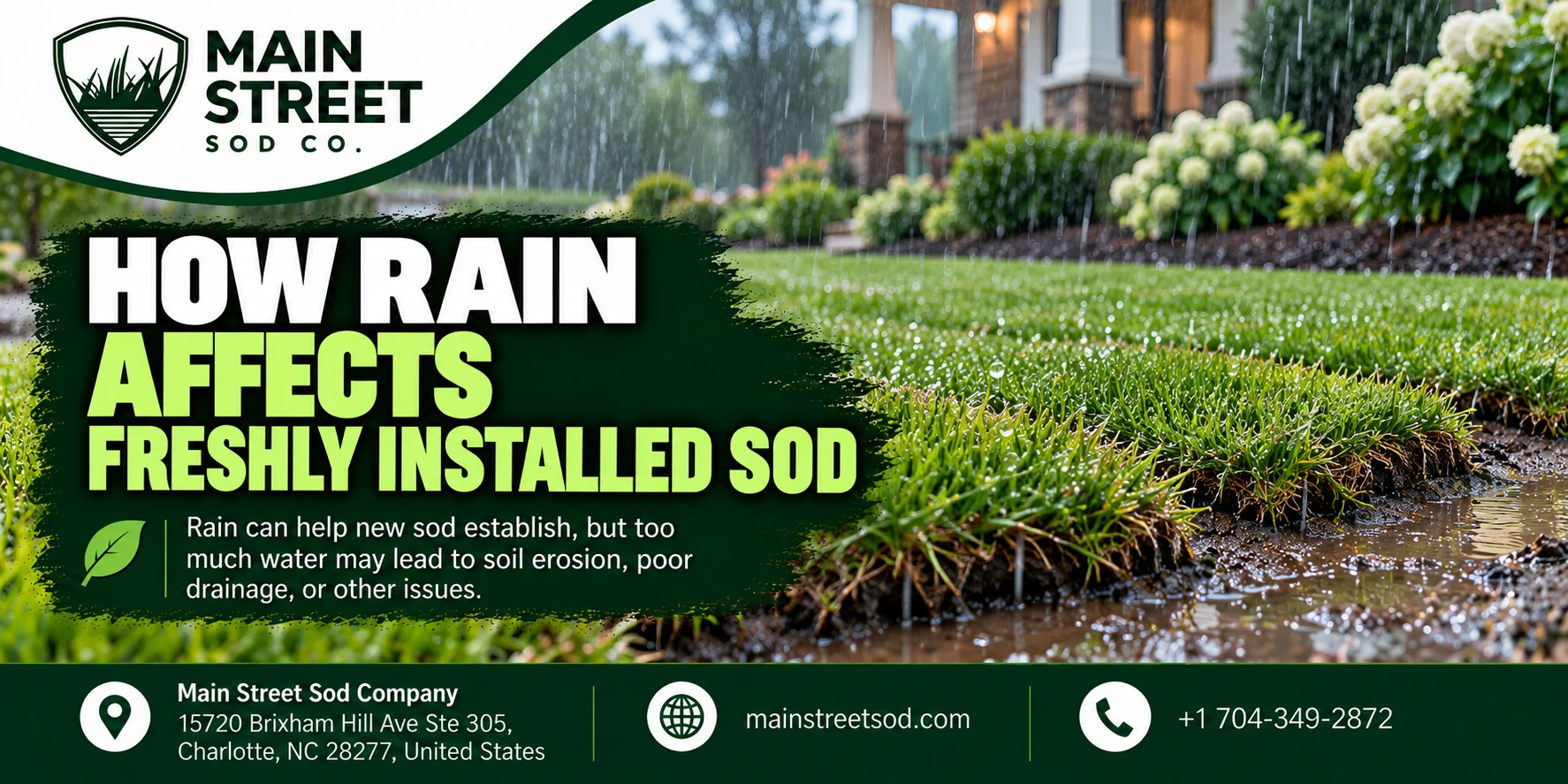
Before sod roots into the underlying soil, individual pieces can still move. Fast-moving surface runoff may shift strips, open seams, erode soil underneath the turf, or move soil downhill.
Saturated ground can create additional problems.
When the soil becomes extremely soft, walking on the lawn may leave depressions or push sod pieces out of position. Excessively wet soil also contains less available air for developing roots.
On slopes, movement is a particular concern. NC State Extension recommends installing sod across the face of slopes and staking pieces when necessary to reduce slippage during establishment.
One heavy storm does not automatically mean the lawn has been damaged.
After the rain stops, inspect for actual signs of movement, erosion, puddling, or unstable soil before deciding whether corrective work is needed.
How Can Rain Cause Sod to Shift or Wash Out?
Fresh sod is not immediately attached to the yard.
At installation, it rests on top of prepared soil. Its roots gradually grow downward and anchor it into the underlying ground.
Until that happens, flowing water can exert enough force to move sections.
The risk is higher on:
- Steeper slopes
- Areas receiving runoff from roofs or pavement
- Low channels where water concentrates
- Newly graded soil
- Sections with weak soil contact
- Areas where sod pieces were not fitted tightly
NC State advises laying sod lengthwise across slopes and securing it where needed specifically to help prevent slippage.
Heavy runoff may also remove soil beneath an otherwise intact-looking piece of sod.
After a storm, look downhill from slopes and drainage routes for sediment deposits, exposed roots, small channels, or pieces that no longer sit at the same level as their neighbors.
If water repeatedly follows the same route and moves soil each time it rains, the issue is no longer just sod aftercare. The property may have a runoff, erosion, or grading problem that needs to be addressed.
Can Standing Water Harm New Sod?
Persistent standing water can interfere with establishment.
New sod needs moisture, but roots also require oxygen. When soil remains saturated for extended periods, air spaces in the soil stay filled with water.
Main Street Sod notes that standing water, soggy low areas, and soil that remains wet long after surrounding sections dry can indicate drainage problems. Those conditions can leave sod excessively wet and make root establishment more difficult.
A temporary puddle during an intense storm does not necessarily mean something is wrong.
Pay more attention to what happens afterward.
If water drains reasonably soon and the soil begins returning to a moist but stable condition, the lawn may be fine.
Potential warning signs include:
- Puddles that remain long after the storm
- The same low spots filling after every rainfall
- Mud beneath the sod
- Sod that feels unusually spongy
- Pieces that remain loose
- Yellowing or declining turf in consistently wet areas
Repeated standing water deserves investigation rather than additional irrigation.
How Should You Adjust Watering After Rain?
Do not water by calendar alone.
After rainfall, check moisture before the next irrigation cycle.
University of Minnesota Extension specifically recommends minimizing irrigation during rainfall events, while NC State recommends adjusting automatic irrigation systems to account for natural precipitation.
For fresh sod, gently inspect the soil underneath a representative section.
If both the sod layer and soil below are still adequately moist, delay the next irrigation.
If the rain was brief and the soil underneath is already drying, supplemental water may still be necessary.
Also check more than one location.
Rainfall may be uniform, but drainage is not. A low area may remain saturated while a sunny slope dries considerably faster.
That means one irrigation decision may not perfectly suit every part of a complicated yard.
As the sod establishes roots, irrigation should gradually transition from frequent establishment watering toward deeper, less frequent watering. Recent rainfall should always be considered when making that adjustment.
How Does Poor Grading Affect Sod During Heavy Rain?
Grading determines where water moves across a property.
A properly prepared lawn should move excess surface water away appropriately rather than concentrating it in unwanted low spots or sending aggressive runoff across vulnerable soil.
Heavy rain can make grading problems much easier to see.
Main Street Sod identifies recurring puddles, soggy low areas, runoff channels, soil loss, persistent muddy areas, and water moving toward structures as signs that drainage or grading may need attention.
A depression may hold water.
A poorly directed slope may channel water across the sod.
A steep area may lose soil beneath the turf.
Correcting these problems is different from simply changing the sprinkler schedule.
New sod does not change the shape of the ground underneath it. If water naturally collects in one area before installation, covering that area with turf does not automatically correct the underlying drainage condition.
Homeowners dealing with persistent low spots or uneven water movement can review Main Street Sod’s grading and leveling services.
What Should You Check After a Storm?
Once the storm has passed and conditions are safe, walk around the perimeter rather than immediately crossing the wet lawn.
Look for patterns.
First, check for standing water.
Then inspect seams. Pieces should still fit together rather than showing newly opened gaps or obvious movement.
Look closely at slopes and areas where water flows from downspouts, driveways, patios, neighboring properties, or higher portions of the yard.
Check for:
- Shifted sod pieces
- Open seams
- Folded or wrinkled turf
- Soil washed onto the grass
- Soil missing beneath edges
- Small erosion channels
- Low spots filled with water
- Saturated or muddy areas
- Exposed sod roots
- Newly uneven sections
Avoid unnecessary traffic while the soil is saturated.
Even undamaged sod can develop footprints or depressions if it is walked on while the ground is very soft.
Finally, check moisture before restarting the irrigation system.
The storm may have already provided everything the lawn needs for the next watering interval.
Can Shifted or Washed-Out Sod Be Corrected?
Minor movement can sometimes be corrected if it is caught early and the sod has not yet rooted.
A piece that has shifted but remains healthy may be carefully returned to position so its edges fit snugly against neighboring pieces.
The soil underneath should still provide a smooth supporting surface and good contact with the turf.
NC State recommends snug seams, good sod-to-soil contact, rolling after placement, and avoiding stretched pieces during installation. Those same principles are useful when restoring a small area that moved before rooting.
If soil washed away from beneath the sod, simply pushing the piece back may not be enough.
The missing or eroded base may first need to be restored so the turf does not sit over a depression or air pocket.
For significant washout, avoid repeatedly moving pieces without addressing why water crossed the area so aggressively.
If runoff caused the damage once, another storm may cause it again.
When Does Storm Damage Need Professional Attention?
Minor puddling or one slightly moved piece may not require professional work.
The concern increases when storm damage reveals an ongoing site problem.
Consider professional evaluation when:
- Large sections of sod have shifted
- Soil has washed away beneath multiple pieces
- Deep channels form through the lawn
- Sod repeatedly moves after storms
- Standing water persists in the same areas
- A slope appears unstable
- Water flows toward the house or another structure
- Large low spots remain saturated
- The lawn becomes noticeably uneven
- Repairs fail after subsequent rainfall
Main Street Sod recommends professional evaluation when a property has recurring standing water, significant elevation changes, soil washing away after storms, unstable slopes, concentrated runoff, or persistent muddy areas.
In those situations, replacing damaged turf without correcting the water movement may only provide a temporary fix.
The underlying grade, runoff path, drainage, or erosion condition may need attention first.
Homeowners can review Main Street Sod’s service areas when installation, grading, or storm-related lawn problems need an on-site evaluation.
FAQs
Is rain after sod installation a good thing?
Usually. Rain can provide useful establishment moisture and reduce the need for irrigation. The important factor is whether it moistens the root zone without leaving the soil saturated or creating damaging runoff.
Should I run my sprinklers if it rained overnight?
Check soil moisture first. If the sod and soil beneath it remain adequately moist, supplemental watering can usually be delayed. Extension guidance recommends reducing irrigation during rainy periods rather than following the same automatic schedule regardless of rainfall.
Can too much rain kill new sod?
Prolonged saturation can interfere with root establishment, and severe runoff can shift sod or erode the underlying soil. A single heavy rain does not necessarily kill the turf, so inspect the lawn for persistent waterlogging, movement, or root problems before assuming the sod is lost.
What should I do if new sod moves after heavy rain?
If the sod is still unrooted and the underlying soil is intact, a small shifted piece may be carefully repositioned so it sits flat with tight seams and good soil contact. More significant movement or soil washout should be evaluated for runoff or grading problems before repairs are repeated.
How long is standing water too long on new sod?
There is no universal number of hours because soil type, storm intensity, temperature, and site drainage vary. The more important warning sign is water that repeatedly remains in the same area long after surrounding sections have drained, leaving the soil persistently soggy or unstable.
Can rain wash away the soil under sod?
Strong concentrated runoff can erode soil, particularly on slopes or where water follows the same channel repeatedly. Check for depressions, exposed edges, sediment downhill, and sod that no longer has firm contact with the soil underneath.
Should I walk on the new sod to inspect it after heavy rain?
Minimize walking while the soil is saturated. Inspect from paved areas and the lawn perimeter first. If you need to enter the lawn, use as little traffic as possible because soft soil can rut or allow newly installed pieces to shift.
How rain affects freshly installed sod ultimately depends on amount, intensity, drainage, soil, slope, and root establishment. Helpful rain can replace irrigation. Excessive rain can reveal low spots, create saturation, or move turf that has not yet rooted.
After a storm, check the lawn before changing anything: inspect moisture, standing water, seams, slopes, and runoff paths first. Then adjust watering or address damage based on what the property actually shows.
Main Street Sod provides professional sod installation along with grading and leveling when site conditions require additional preparation. Homeowners can also review Main Street Sod’s service areas for local availability.