The best sod for shady yards in Charlotte, NC depends on how much usable sunlight the lawn actually receives, along with soil, drainage, tree coverage, traffic, and maintenance expectations. Tall fescue is often worth considering for partially shaded Charlotte-area lawns, while certain Zoysia varieties can also perform in partial shade. Bermuda generally needs considerably more sun and is usually a poor choice for heavily shaded areas.
No turfgrass performs well without enough light. Even grasses described as shade tolerant still need meaningful sunlight, and a yard beneath a dense tree canopy may be too dark for healthy sod regardless of the variety.
Before choosing turf, homeowners should evaluate the yard throughout the day rather than judging it from a single morning or afternoon observation. The best choice is the grass that fits the property’s overall growing conditions, not simply the variety with the strongest “shade tolerant” label.
What Is the Best Sod for Shady Yards in Charlotte, NC?
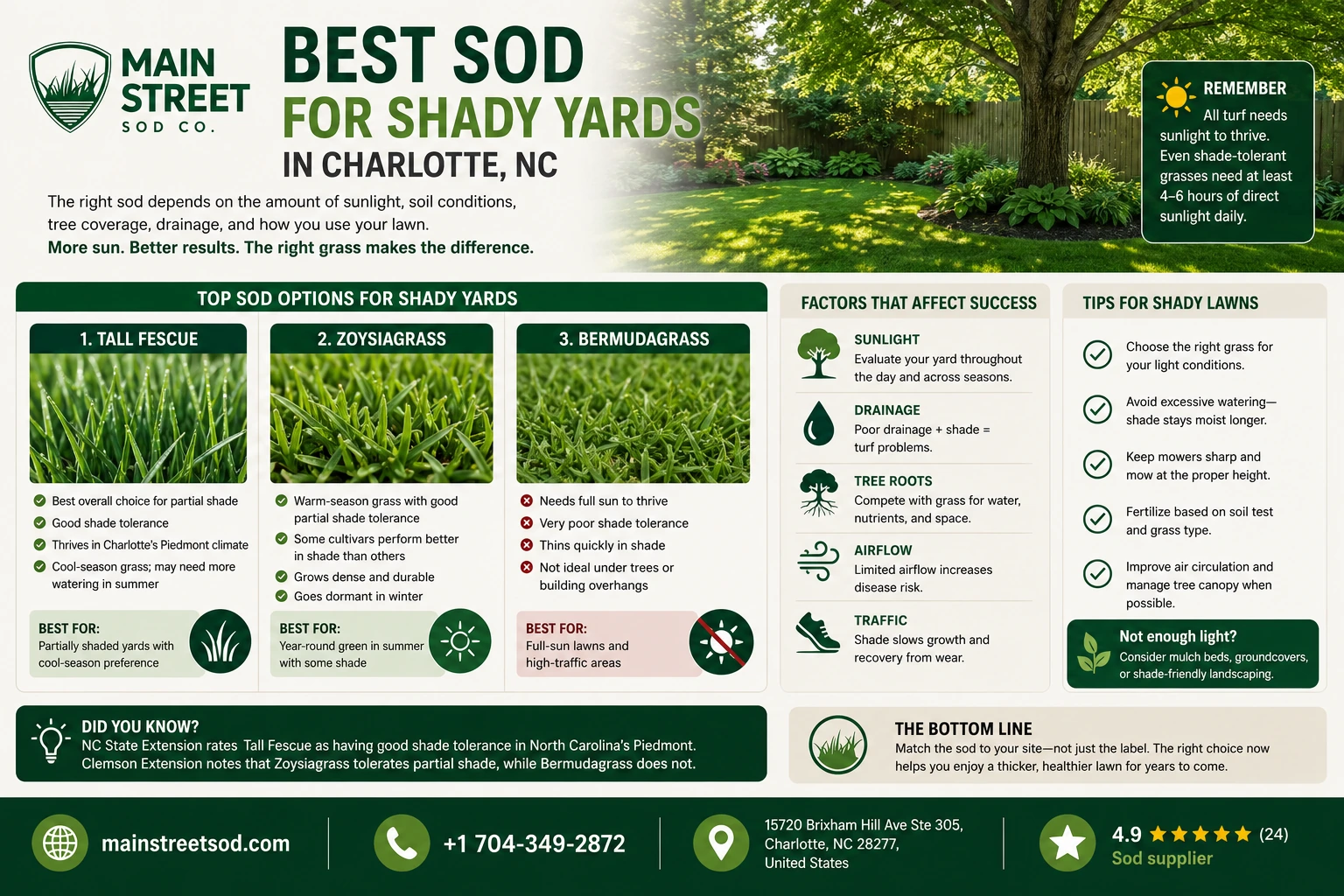
For many Charlotte yards with partial shade, tall fescue is one of the first turf types worth evaluating because it offers relatively good shade tolerance compared with many commonly used lawn grasses.
NC State Extension rates tall fescue as having good shade tolerance in North Carolina and lists it as adapted across the state’s Piedmont region. Zoysiagrass can also be considered in shaded conditions, although performance varies by cultivar and the amount of available light.
Bermudagrass sits at the other end of the spectrum. It has very poor shade tolerance and generally performs best where it receives abundant direct sunlight. Clemson Extension specifically advises against growing typical Bermudagrass beneath tree canopies or building overhangs.
That does not make fescue universally “best.” A sunny backyard with one lightly shaded corner may call for a different approach than a front lawn covered by mature hardwoods.
The amount and type of shade should drive the decision.
How Much Shade Can Sod Tolerate?
“Shade” can describe very different lawn conditions.
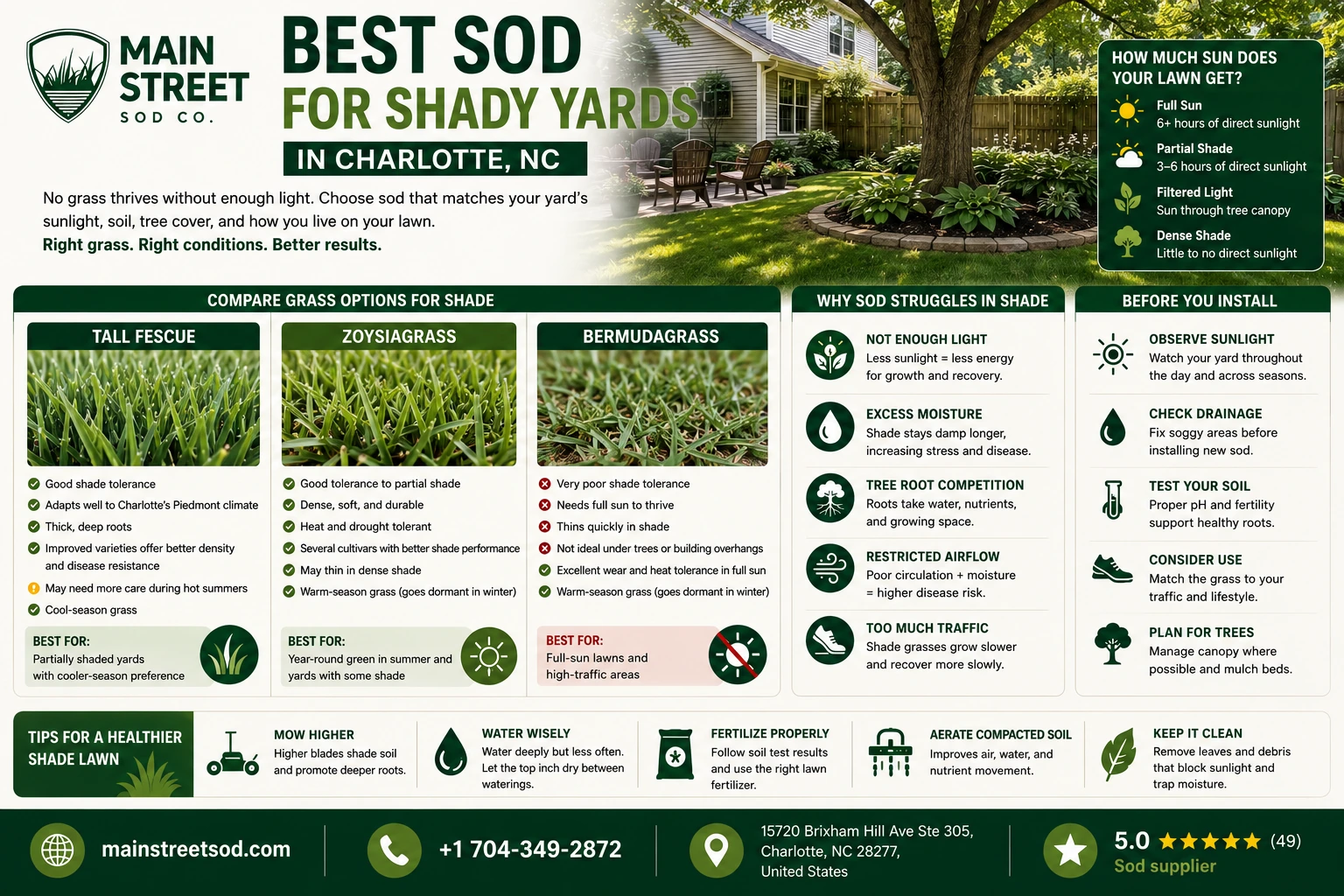
A yard may receive:
- Full sun: direct sunlight for most of the day
- Partial shade: several hours of direct sunlight with shade during another portion of the day
- Filtered or dappled light: sunlight passing through a tree canopy
- Dense shade: little meaningful direct or filtered sunlight
These conditions are not interchangeable.
Extension guidance notes that all turfgrasses perform best in full sun. Some turf types, including tall fescue and certain Zoysia grasses, can tolerate reduced light better than others, but they still need enough sunlight to maintain healthy growth. Clemson’s turf guidance notes that some shade-tolerant grasses can perform with roughly four to six hours of direct sunlight, although cultivar and site conditions affect results.
That range should be treated as a guideline rather than a guarantee.
Four hours of strong midday sunlight can affect a lawn differently than four hours of weak, filtered light beneath dense trees. Tree roots, airflow, soil moisture, and traffic can further change the result.
What Grass Types Perform Best in Partial Shade?
Charlotte homeowners have several turf types to consider, but their shade tolerance and seasonal behavior differ substantially.
Tall fescue
Tall fescue is a cool-season grass with good shade tolerance compared with many warm-season options. It remains one of the more practical choices for partially shaded Piedmont lawns.
Its tradeoff is summer stress. Tall fescue is better suited to cooler growing conditions than warm-season grasses and may need more attention during hot periods.
Zoysiagrass
Zoysia can be another useful option where a homeowner wants warm-season turf with some shade tolerance.
Shade performance varies significantly among Zoysia cultivars. Clemson Extension notes that Zoysia generally grows in full sun and partial shade but tends to thin in dense shade. Some cultivars have been developed or selected for better shade performance than others.
Zoysia also has a different seasonal appearance from fescue because it is a warm-season grass and goes dormant as temperatures cool.
Bermudagrass
Bermuda is an excellent full-sun turf but is usually one of the weakest choices for shaded lawns.
Traditional Bermudagrasses have very poor shade tolerance, which makes them poorly suited to lawns beneath mature trees or consistently shaded structures. Some specialized cultivars may handle limited shade better, but Bermuda should generally be considered a sun-loving turf.
Other warm-season options
Other grasses may be appropriate under certain site conditions, but shade is only one part of the decision.
Centipedegrass, for example, has some shade tolerance but is not typically as shade-adapted as the strongest options. St. Augustinegrass can tolerate shade well, but regional adaptation, winter conditions, availability, and individual property characteristics also need to be considered.
For Charlotte homeowners, the practical comparison is usually less about finding the single most shade-tolerant grass on paper and more about finding turf that can tolerate both the property’s shade and the broader Piedmont growing environment.
Is Fescue a Good Choice for Shady Yards?
Yes, tall fescue can be a good choice for many Charlotte lawns with partial shade.
Its shade tolerance is one of the reasons it is commonly considered for lawns where direct sunlight is limited. NC State lists tall fescue among grasses suitable for shaded conditions in the Piedmont.
Improved turf-type tall fescues can also offer better turf quality and shade performance than older varieties. Clemson Extension notes that newer turf-type cultivars generally provide better density and shade tolerance than older Kentucky-31-type fescue.
However, shade tolerance is only half the equation.
Charlotte summers can create heat stress for cool-season turf, and tall fescue may require more attention to remain dense and attractive through warm conditions. It may also thin over time and need periodic renovation depending on the site and maintenance level.
Homeowners considering this option can learn more about its characteristics on our Fescue Turf Page.
Fescue may make sense when a lawn receives partial sunlight and the homeowner is comfortable with the maintenance characteristics of a cool-season grass. A very sunny, high-heat lawn may favor another turf type, while an extremely dark lawn may not support healthy fescue either.
How Do Warm-Season Grasses Perform in Shade?
Warm-season grasses differ considerably in their ability to handle shade.
Bermuda generally needs strong sunlight and tends to thin quickly when light is limited. That makes it a poor fit for many tree-covered yards.
Zoysia is typically more shade tolerant than Bermuda. Clemson Extension describes Zoysiagrass as capable of growing in partial shade, although it can thin in dense shade and individual cultivars vary.
This distinction matters when homeowners want the heat tolerance and summer growth of warm-season turf but have portions of the yard that receive limited sunlight.
Even a relatively shade-tolerant warm-season grass should not be expected to create dense turf in a location that receives almost no light.
The more heavily shaded the site becomes, the more important it is to evaluate whether turfgrass is realistic at all.
Why Does Some Sod Fail in Shaded Yards?
Insufficient sunlight is an obvious reason sod can struggle, but it is not the only one.
Shaded lawn areas often have several unfavorable growing conditions at the same time.
Too little sunlight
Grass depends on light for photosynthesis and growth.
When the lawn receives less light than the selected turf requires, growth may become weak and thin. Over time, bare areas may develop even if the sod initially looks healthy after installation.
Excessive moisture
Shady locations can dry more slowly because they receive less sun.
If drainage is poor or irrigation is excessive, the soil may remain wet for extended periods. Consistently wet conditions can weaken turf and increase the likelihood of disease problems.
Tree-root competition
Grass growing beneath trees is competing with those trees for water, nutrients, and physical growing space.
Large, established root systems can make the turf’s environment more challenging even when some sunlight reaches the ground.
Restricted airflow
Dense tree canopies, fences, buildings, and landscape features can restrict airflow.
Shade combined with persistent moisture and limited air movement may create conditions that are less favorable for healthy turf and more favorable for certain diseases. NC State identifies disease pressure as one of the challenges associated with turf grown in shade.
Too much traffic
Shaded turf often grows less vigorously than turf in full sun.
That means it may recover more slowly from children playing, pets running, frequent walking, or other heavy use.
The wrong grass for the site
Sometimes the installation is not the main problem—the variety simply does not match the conditions.
Installing sun-loving Bermuda beneath mature shade trees, for example, can lead to thinning even when the sod was healthy at installation.
How Can You Measure Sunlight Before Choosing Sod?
A useful first step is to observe the yard over an entire day.
Do not look outside once at noon and assume that tells you how much sun the lawn receives.
Instead, check several areas of the property at different times, such as:
- Early morning
- Late morning
- Around midday
- Mid-afternoon
- Late afternoon
Note whether each area receives direct sunlight, filtered light, or full shade.
A simple sketch or photo record can help. Divide the lawn into sections and write down approximately when direct light reaches each area.
Repeat the observation if possible.
Sun exposure also changes with the seasons. Deciduous trees may create much heavier shade after leafing out than they do in winter, and changing sun angles can alter which parts of the yard receive direct light.
If you are planning sod beneath trees, evaluate the lawn when the canopy is actually full rather than relying only on winter sunlight.
This gives you a more realistic picture of what the grass will experience during the growing season.
What Other Factors Matter Besides Sunlight?
Sun exposure is important, but successful turf selection should account for the entire property.
Soil
Different turf types perform best under different soil conditions.
Soil compaction, fertility, pH, and the condition of the existing soil can all influence turf establishment and long-term performance.
Drainage
A shaded area that stays wet after every rainfall presents a different challenge from a shaded area with well-drained soil.
Poor drainage should be considered before turf selection rather than expecting a different grass variety to solve the underlying problem.
Irrigation
Shade can reduce water needs because the soil may dry more slowly.
Applying the same irrigation schedule to a sunny lawn and a shaded lawn can result in overwatering some areas.
Foot traffic
Think about how the lawn will actually be used.
A shaded ornamental front lawn may have different requirements from a backyard where children and pets frequently play.
Tree coverage
Tree species, canopy density, root competition, and tree placement can all influence whether sod is practical.
Slope
Sloped yards may drain and dry differently from flat sites. They can also create installation and erosion concerns that influence turf establishment.
Choosing sod based on all of these conditions produces a better decision than focusing on shade tolerance alone.
Can You Grow Sod Under Trees?
Sometimes but mature trees can make turf establishment particularly challenging.
The grass beneath a tree may face three problems at once: reduced sunlight, competition from tree roots, and lower airflow.
Rainfall may also be intercepted by the canopy, while other areas beneath trees may stay damp for long periods after irrigation.
The density of the canopy matters considerably.
A large tree that allows filtered sunlight throughout the day may still leave enough light for a shade-tolerant turf. A group of mature trees that creates dense, nearly continuous shade may not.
Homeowners can sometimes improve growing conditions through appropriate tree management, but avoid aggressive root disturbance or pruning solely to force grass into an unsuitable location without professional guidance.
There is also a point where sod simply is not the best landscape material.
If repeated attempts to grow grass beneath dense tree cover have failed, consider whether a shade-tolerant groundcover, mulch bed, planting area, or another landscape treatment would be more appropriate than repeatedly replacing sod.
How to Choose Sod for Charlotte Growing Conditions
Charlotte sits in North Carolina’s Piedmont region, where homeowners need to consider both periods of summer heat and cooler seasonal conditions when selecting turf.
NC State’s regional turf guidance includes tall fescue as an option for the Piedmont, and its shade-management guidance rates tall fescue as having good shade tolerance. Zoysia can also work in Piedmont landscapes, particularly when homeowners want warm-season turf, but cultivar-specific shade performance should be considered.
A practical selection process looks at several questions together:
- How much direct or filtered sunlight reaches the lawn?
- Does that exposure change significantly across the property?
- Is the area beneath mature trees?
- Does the soil drain well or stay wet?
- How heavily will the lawn be used?
- Does the homeowner prefer a cool-season or warm-season appearance?
- What level of maintenance is realistic?
A partially shaded yard may point toward fescue or an appropriate Zoysia cultivar.
A mostly sunny lawn may create more options.
A heavily shaded area with little usable light may be better treated as a landscaping problem rather than a turf-selection problem.
When to Consider Professional Sod Installation
Professional input can be especially valuable when a property has mixed sun and shade.
A yard may contain a sunny front section, a partially shaded side yard, and dense shade beneath backyard trees. Treating all three areas as though they have identical growing conditions can lead to disappointing results.
A sod professional can evaluate factors such as:
- Sun exposure
- Tree canopy
- Soil condition
- Drainage
- Yard use
- Existing turf problems
- Appropriate grass types for the site
The goal is not simply to install sod quickly. It is to select turf with a realistic chance of performing well in the location where it will be placed.
Homeowners planning a new lawn or replacing problem turf can learn more on our Sod Installation Page.
For information about where Mainstreet Sod provides service in and around the Charlotte area, visit our Service
FAQs
What sod grows best in shade in Charlotte, NC?
Tall fescue is often a strong candidate for partially shaded Charlotte-area lawns because it has relatively good shade tolerance and is adapted to North Carolina’s Piedmont. Certain Zoysia cultivars may also perform well in partial shade. The best choice depends on the amount of light, soil, drainage, tree cover, and how the lawn will be used.
Will fescue grow in full shade?
Fescue tolerates shade better than many turfgrasses, but it still needs meaningful light. Dense areas that receive little direct or filtered sunlight may not support healthy turf even if fescue is used.
Can Zoysia tolerate shade?
Yes, Zoysia generally tolerates partial shade better than Bermuda, and some cultivars have particularly good shade tolerance. However, Zoysia commonly thinns when grown in dense shade.
Does Bermuda grass grow well under trees?
Usually not. Bermudagrass has very poor shade tolerance and generally performs poorly beneath dense tree canopies or other areas that block direct sunlight.
How many hours of sunlight does sod need?
Requirements vary by grass type, cultivar, and site. Extension guidance notes that some shade-tolerant turfgrasses may perform with approximately four to six hours of direct sunlight per day, but the intensity and quality of that light also matter.
Can sod survive beneath mature trees?
It can in some locations, particularly where the canopy allows enough sunlight through. Mature trees also create root competition, moisture differences, and reduced airflow, so light alone does not determine whether turf will succeed.
What should I do if my yard is too shady for grass?
If an area receives too little light to maintain healthy turf, repeatedly installing new sod may not solve the problem. Consider whether selective landscape changes or alternatives such as mulch, shade-adapted plantings, or other groundcovers would be more suitable.
Find the Turf That Fits Your Yard, Not Just the Label
A shady Charlotte yard does not automatically rule out a healthy lawn, but it does make turf selection more important. Fescue, certain Zoysia varieties, and other grasses can handle partial shade to different degrees, while sun-loving turf such as Bermuda is generally less suited to low-light areas.
At Mainstreet Sod, we can help you look beyond the grass variety itself and consider the conditions that will determine how the lawn performs sunlight, trees, drainage, soil, traffic, and the way you plan to use the property.
If you’re deciding which sod makes sense for a shaded or mixed-light Charlotte yard, consider having the site evaluated before ordering turf. Choosing for the conditions you actually have can help avoid thinning grass and repeated replacement later.