Yes, established tree roots can make it difficult for sod to establish and remain healthy. When homeowners notice tree roots preventing sod from growing, the problem is usually not the roots alone. Mature trees can compete with grass for water, nutrients, and growing space while their canopies also reduce the amount of sunlight reaching the lawn.
That combination can make the area beneath a tree one of the most difficult places in the yard to establish new turf.
Before replacing thin or bare grass with new sod, it helps to determine whether the main problem is root competition, excessive shade, or both. Installing fresh sod without addressing those conditions may result in another struggling patch of grass.
At Main Street Sod, we recommend looking at the entire growing environment before deciding which turf makes sense. In some areas, a more shade-tolerant grass may perform better. In others, the conditions beneath a mature tree may simply be better suited to mulch or another landscape treatment instead of repeatedly replacing sod.
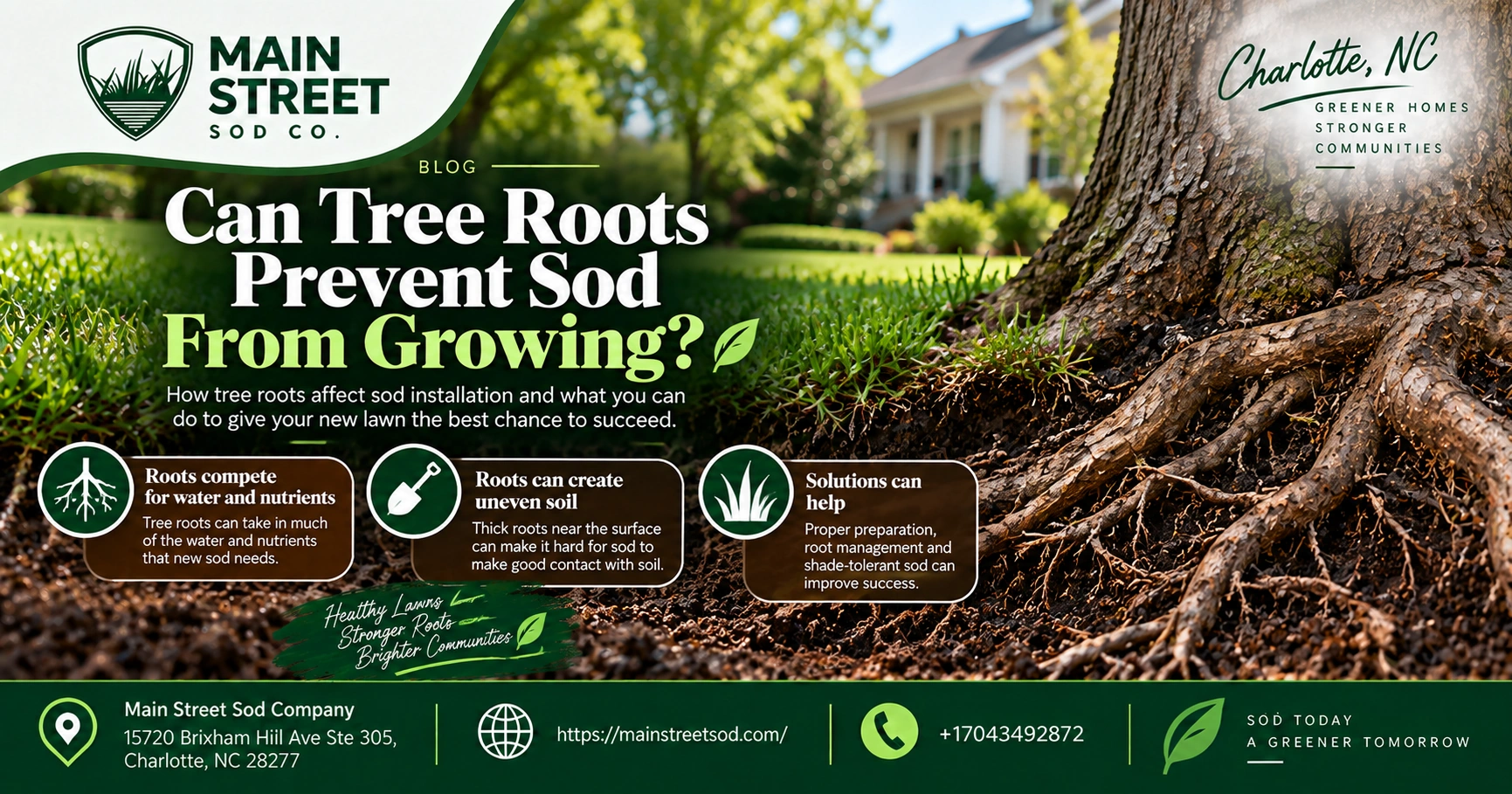
Can Tree Roots Prevent Sod From Growing?
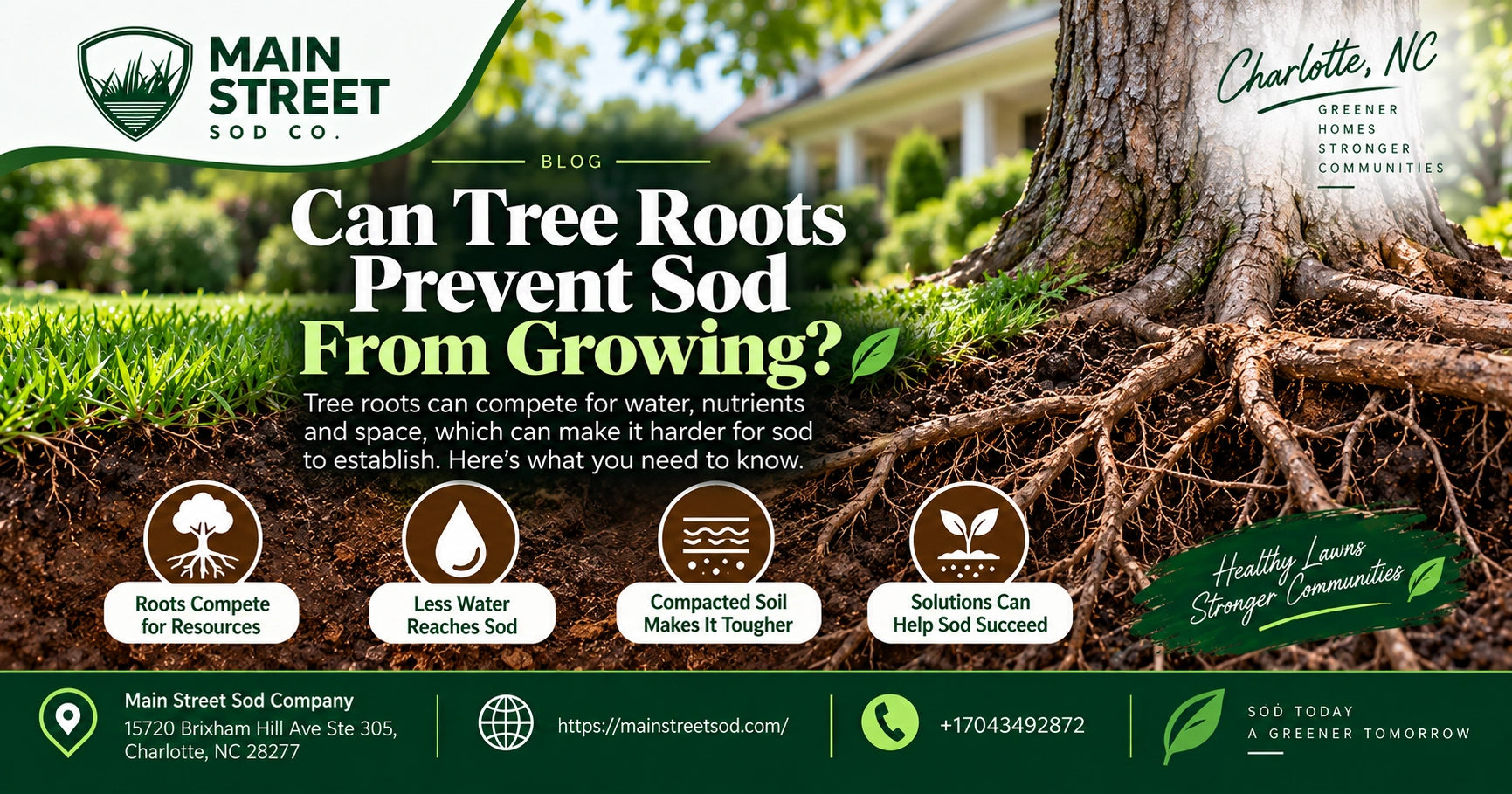
Tree roots can interfere with sod growth, but they do not automatically make grass impossible to grow.
The biggest issue is competition.
A mature tree and a lawn are both living plants drawing resources from the same area of soil. Tree roots can occupy a large portion of the upper soil profile, leaving less moisture, nutrients, and physical space available to developing grass roots.
New sod is particularly vulnerable because its roots are initially concentrated close to the surface. Until those roots grow into the soil below, the sod depends heavily on consistent moisture and good soil contact.
If the area beneath a tree is already packed with roots, dry soil, and heavy shade, the new sod may have difficulty establishing.
How much difficulty depends on several factors:
- The size and species of the tree
- How dense the root system is near the surface
- How much sunlight reaches the lawn
- The condition of the soil
- Irrigation coverage
- The turf variety
- How much space exists between the soil surface and exposed tree roots
That is why some lawns remain healthy around trees while others develop thin, bare circles beneath them.
How Do Tree Roots Compete With Sod?
Trees and turf need many of the same resources.
When they occupy the same growing area, the larger and more established plant usually has an advantage.
Competition for moisture
Water is one of the biggest challenges for grass growing beneath established trees.
A mature tree can draw substantial moisture from the surrounding soil. At the same time, the tree canopy may intercept some rainfall before it ever reaches the lawn below.
This can create a situation where the area looks shaded and damp but the soil around the grass roots actually dries quickly.
New sod needs consistent moisture during establishment. If tree roots are continuously drawing water from that same root zone, irrigation may need closer monitoring.
Adding more water is not always the solution, however. Excessive irrigation can create problems elsewhere in the lawn or encourage poor growing conditions.
Competition for nutrients
Trees and turf also rely on nutrients from the soil.
A dense network of established tree roots can compete with grass roots for available nutrients, particularly in areas where the soil is already limited or compacted.
This does not mean homeowners should automatically apply more fertilizer. Poor grass performance beneath a tree may be caused by shade or restricted root space rather than a simple nutrient shortage.
Competition for growing space
Healthy sod needs room for roots to grow into the soil.
Large tree roots near the surface can reduce the amount of usable soil available for turf roots. In some yards, the soil may contain so many woody roots that new sod cannot develop the same root system it would in an open part of the lawn.
Trying to cut away major tree roots to make more room for grass can harm the tree and should not be treated as a normal sod-preparation method.
The better approach is to work with the existing conditions and decide whether turf is appropriate for that area.
What Are the Signs Tree Roots Are Affecting Your Grass?
Poor grass underneath a tree does not automatically prove that roots are responsible. Look at how the problem appears across the lawn.
Several patterns can point toward root competition.
Grass struggles directly over dense surface roots
If turf becomes increasingly thin as visible roots become more concentrated, limited soil and root space may be contributing to the problem.
You may also notice grass growing reasonably well several feet away but becoming sparse closer to the trunk.
The soil dries quickly beneath the tree
Check the soil rather than judging moisture from the grass alone.
If areas beneath the tree regularly dry faster than nearby lawn areas, the established root system may be competing heavily for available moisture.
Sod establishes well elsewhere but struggles beneath trees
A useful comparison is the rest of the lawn.
If sod installed at the same time performs well in open areas but remains thin or weak underneath mature trees, the tree environment deserves closer attention.
The soil is difficult to prepare
In some cases, there may be so many shallow roots that preparing a smooth, consistent soil surface becomes difficult.
Good sod installation depends on close contact between the sod and prepared soil. Large exposed roots, uneven soil, and very limited growing space can interfere with that contact.
Grass remains thin despite reasonable lawn care
If watering and normal maintenance produce healthy turf across most of the property but one tree-covered area remains consistently bare, the problem may not be routine lawn care.
Shade, roots, or both may be limiting what turf can realistically do in that space.
Is the Problem Tree Roots or Too Much Shade?
Roots frequently get blamed for poor grass beneath trees, but sunlight may be just as important.
Many turfgrasses need several hours of useful sunlight each day to maintain dense growth. A mature tree canopy can dramatically reduce both the amount and intensity of light reaching the lawn.
You can often narrow down the cause by looking at the pattern.
Signs shade may be the bigger problem
Shade is more likely to be the primary limitation when:
- Grass becomes thin throughout the entire area beneath the canopy
- Areas receiving more afternoon or morning sun perform noticeably better
- The soil has adequate moisture but turf still remains weak
- Grass becomes stretched, sparse, or less dense
- The problem closely follows the tree’s shadow pattern
Some areas may receive plenty of daylight without receiving enough direct or filtered sunlight for the turf variety growing there.
Signs root competition may be more important
Roots may play a larger role when:
- Soil dries unusually quickly near the tree
- Surface roots occupy much of the planting area
- Grass struggles most where roots are densest
- There is little loose soil available for turf roots
- Lawn performance declines close to the trunk even where sunlight is reasonably good
Often, it is both
Around established trees, shade and root competition frequently occur together.
The tree canopy reduces sunlight while the root system competes for moisture and growing space. Improving only one condition may therefore not solve the entire problem.
For example, choosing a more shade-tolerant grass can help when low light is the primary issue. But even shade-tolerant turf can struggle if the ground is extremely root-bound and dry.
Before installing new sod, evaluate both conditions rather than assuming one explanation.
What Grass Options Work Better Near Trees?
The right grass depends on the amount of sunlight, climate, soil conditions, irrigation, and level of root competition.
No grass should be described as thriving in every heavily shaded location. However, some turf types generally tolerate partial shade better than grasses that require strong sunlight.
Consider how much sunlight the area actually receives
Observe the lawn at several points throughout the day.
A section that looks shaded in the morning may receive several hours of afternoon sun. Another area may remain beneath dense tree cover almost all day.
Those are very different growing environments.
Fescue may be an option for partially shaded areas
Main Street Sod offers Fescue grass, which can be considered for lawns where partial shade is a concern.
The important word is partial.
Choosing a shade-tolerant grass does not eliminate the need for sufficient light, soil, moisture, and growing space. An area that receives very little usable sunlight can remain difficult even with a more shade-tolerant turf.
Turf selection should consider the entire yard
Avoid choosing grass based on the area beneath one tree alone.
Consider:
- Sun exposure across the property
- Seasonal shade changes
- Irrigation
- Soil conditions
- Foot traffic
- Maintenance preferences
- Local growing conditions
A turf variety needs to make sense for the larger lawn as well as the challenging areas within it.
Homeowners can also explore Main Street Sod’s service areas when planning sod projects in the communities we serve.
When Is Sod Not the Best Choice Around Trees?
Sometimes the most practical decision is not to force grass into an area where the growing conditions consistently work against it.
If sod has repeatedly failed underneath the same mature tree, replacing it again without changing anything may simply repeat the problem.
Sod may not be the best choice when:
- The area receives very little usable sunlight
- Large tree roots cover much of the soil surface
- There is insufficient soil depth for grass roots
- The ground dries extremely quickly because of root competition
- Newly installed turf has repeatedly failed in the same location
- Maintaining grass would require excessive watering
- The tree’s health could be compromised by aggressive soil or root disturbance
In those situations, another landscape treatment may be more practical.
Mulch can provide a cleaner transition
A properly planned mulch bed around a mature tree can eliminate the need to grow turf immediately against the trunk or over heavily exposed roots.
It can also create a more intentional boundary between healthy lawn areas and places where grass naturally struggles.
Avoid piling mulch against the tree trunk.
Alternative ground covers may make sense
Depending on the property and local conditions, a shade-adapted ground cover or another landscape treatment may perform better than turf in very low-light areas.
The goal should be a landscape that works with the growing conditions rather than one that requires continuously replacing grass.
Protect the tree while improving the lawn
Major roots should not be casually cut, removed, buried, or damaged simply to create space for sod.
Mature trees can add substantial value and character to a landscape, and their root systems are essential to their health and stability.
If preparing an area for sod installation would require significant disturbance around a valuable tree, it may be worth reconsidering how much of that area should actually remain turf.
A Healthy Lawn Starts With the Right Expectations
Grass can grow around many mature trees, but the conditions beneath those trees are often more challenging than the rest of the yard.
Before installing sod, look at three things: sunlight, root competition, and soil moisture.
If the area receives reasonable light and has enough usable soil, selecting an appropriate turf and managing irrigation carefully may produce a healthy lawn.
If dense roots and heavy shade dominate the area, repeatedly replacing sod may not provide the result you want.
At Main Street Sod, we help homeowners look at the actual growing conditions before choosing turf. The goal is not simply to put sod everywhere there is bare soil. It is to choose and install grass where it has a reasonable opportunity to establish and perform well.
FAQs
Can tree roots stop new sod from rooting?
They can make establishment more difficult. Dense tree roots compete with new sod for moisture, nutrients, and physical growing space. The effect is often stronger when heavy shade is also present.
Will sod grow over exposed tree roots?
Sod generally performs best when it has consistent contact with prepared soil. Large exposed tree roots create uneven surfaces and leave limited soil for turf roots to develop. Covering significant roots with additional soil or cutting them should not be done casually because it may affect tree health.
How can I tell if shade is killing my grass?
Watch how much direct or filtered sunlight the area receives throughout the day and compare grass performance with sunnier sections nearby. If the turf becomes thin throughout the tree’s shaded canopy even where soil moisture appears adequate, insufficient light may be a major factor.
What grass grows better under trees?
Some turf types tolerate partial shade better than others. Fescue can be considered in suitable partially shaded conditions, but no grass is guaranteed to perform well in deep shade with heavy root competition.
Should I remove tree roots before laying sod?
Avoid cutting major tree roots simply to make room for sod. Root removal can damage or destabilize a tree. When roots occupy too much of the area for healthy turf establishment, changing the landscape around the tree may be better than forcing sod into the space.
What should I do if sod keeps dying under the same tree?
First determine whether the main limitation is shade, root competition, moisture, soil depth, or a combination of those conditions. If the site cannot reasonably support turf, consider expanding a mulch bed or using another appropriate landscape treatment rather than repeatedly replacing sod.