Sprinkler coverage affects new sod establishment by determining whether every section receives enough consistent moisture to keep the sod alive and encourage roots to grow into the soil below. Uneven coverage can leave some areas too dry while others remain saturated, creating inconsistent rooting, discoloration, and weak establishment.
New sod depends heavily on reliable irrigation because its root system has not yet developed enough to access moisture deeper in the soil. Checking sprinkler distribution early helps homeowners identify dry zones, excessive watering, blocked spray patterns, and other irrigation problems before they affect lawn development.
Why Even Sprinkler Coverage Matters for New Sod
New sod needs consistent moisture across the entire installation area. Because the grass initially has shallow roots, it cannot compensate effectively when one section of the lawn receives much less water than another.
Good sprinkler coverage helps keep both the sod and the underlying soil appropriately moist during establishment. This creates better conditions for roots to begin growing downward and connecting the sod to the prepared soil.
Coverage matters as much as watering frequency.
Running an irrigation system longer will not necessarily solve poor distribution. If one sprinkler misses a corner while another repeatedly waters the same area, increasing runtime may saturate one section without supplying enough moisture to the dry section.
Edges can require particular attention because they may dry faster than central areas. Sod next to pavement, driveways, sidewalks, walls, or other heat absorbing surfaces can also lose moisture quickly.
The goal is uniform moisture rather than simply operating every sprinkler zone for the same number of minutes.
What Are the Signs of Poor Sprinkler Coverage?
Uneven color is one of the most noticeable signs of inadequate sprinkler coverage. Some sections may remain green while neighboring areas begin appearing dull, grayish, yellow, or brown.
Sod may also feel noticeably different from one location to another.
A dry area may feel lighter, warmer, or less firmly connected to the soil. Sections receiving adequate moisture should gradually become more difficult to lift as roots begin establishing.
Visible boundaries between healthy and stressed grass can provide another clue. A dry patch that follows the edge of a sprinkler pattern may indicate that water is not reaching that location effectively.
Homeowners should also watch the sprinklers while they operate.
A head may be blocked by grass, positioned incorrectly, damaged, tilted, or spraying in the wrong direction. Wind can also push fine spray away from its intended area.
Checking soil moisture in several locations provides better information than judging irrigation from appearance alone.
How Can Uneven Watering Affect Sod Rooting?
Uneven watering creates different growing conditions across the same lawn. Sod receiving appropriate moisture may begin rooting normally while dry sections struggle to establish.
New roots need moisture in the soil beneath the sod.
If only the grass surface becomes wet while the soil underneath remains dry, roots have less favorable conditions for downward development. Dry sod can also shrink slightly, making seams between pieces more noticeable.
Overwatered areas present a different problem.
Constantly saturated soil can limit the balance of moisture and oxygen around developing roots. Excess water may also create soft areas, encourage runoff, or keep sections wetter than necessary.
How can you check early rooting?
After the sod has had time to begin establishing, gently test a small section rather than repeatedly pulling up large areas.
Increasing resistance can indicate that roots are beginning to connect with the soil below. Sections that remain loose while surrounding sod becomes established may deserve closer inspection for moisture or soil contact problems.
Consistent irrigation helps the lawn develop more uniformly instead of creating separate wet and dry zones.
How to Test Water Distribution Across a New Lawn
A simple irrigation distribution test can show whether different areas are receiving similar amounts of water.
Place several identical straight sided containers throughout one sprinkler zone. Include containers near sprinkler heads, between heads, along edges, and in areas that appear unusually wet or dry.
Run the irrigation zone for a measured period.
Afterward, compare the amount of water collected in each container. Large differences can indicate uneven coverage even when the entire lawn appears wet from a distance.
What else should you inspect?
Watch each zone while it runs.
Look for sprinklers that fail to rise properly, spray against landscaping, overshoot the lawn, or leave obvious gaps. Check whether neighboring sprinkler patterns overlap sufficiently to provide reasonable distribution.
Repeat the process for separate zones because performance can vary across the property.
The test does not need to be complicated. Its purpose is to identify meaningful differences so irrigation can be corrected before new sod experiences prolonged moisture stress.
Recheck coverage after adjustments to confirm that the changes improved distribution.
What Causes Dry Zones in Newly Installed Sod?
Dry zones can develop for several reasons, and the sprinkler runtime is only one possibility.
A sprinkler head may be clogged, damaged, too low, incorrectly adjusted, or obstructed by plants or other objects. Changes in water pressure can also affect spray distance and distribution.
Spacing matters as well.
If sprinkler heads do not provide adequate overlapping coverage, areas between them may consistently receive less water. Wind can make this problem more noticeable by changing where smaller droplets land.
Site conditions can create localized drying even when irrigation equipment works properly.
Areas next to pavement and other hot surfaces may lose moisture faster. Slopes may shed water before enough moisture penetrates the soil. Different soil conditions can also affect how quickly water enters or leaves an area.
New sod itself should be checked for good contact with the prepared soil.
Identifying the cause of a dry zone is more effective than simply adding watering time to the entire lawn.
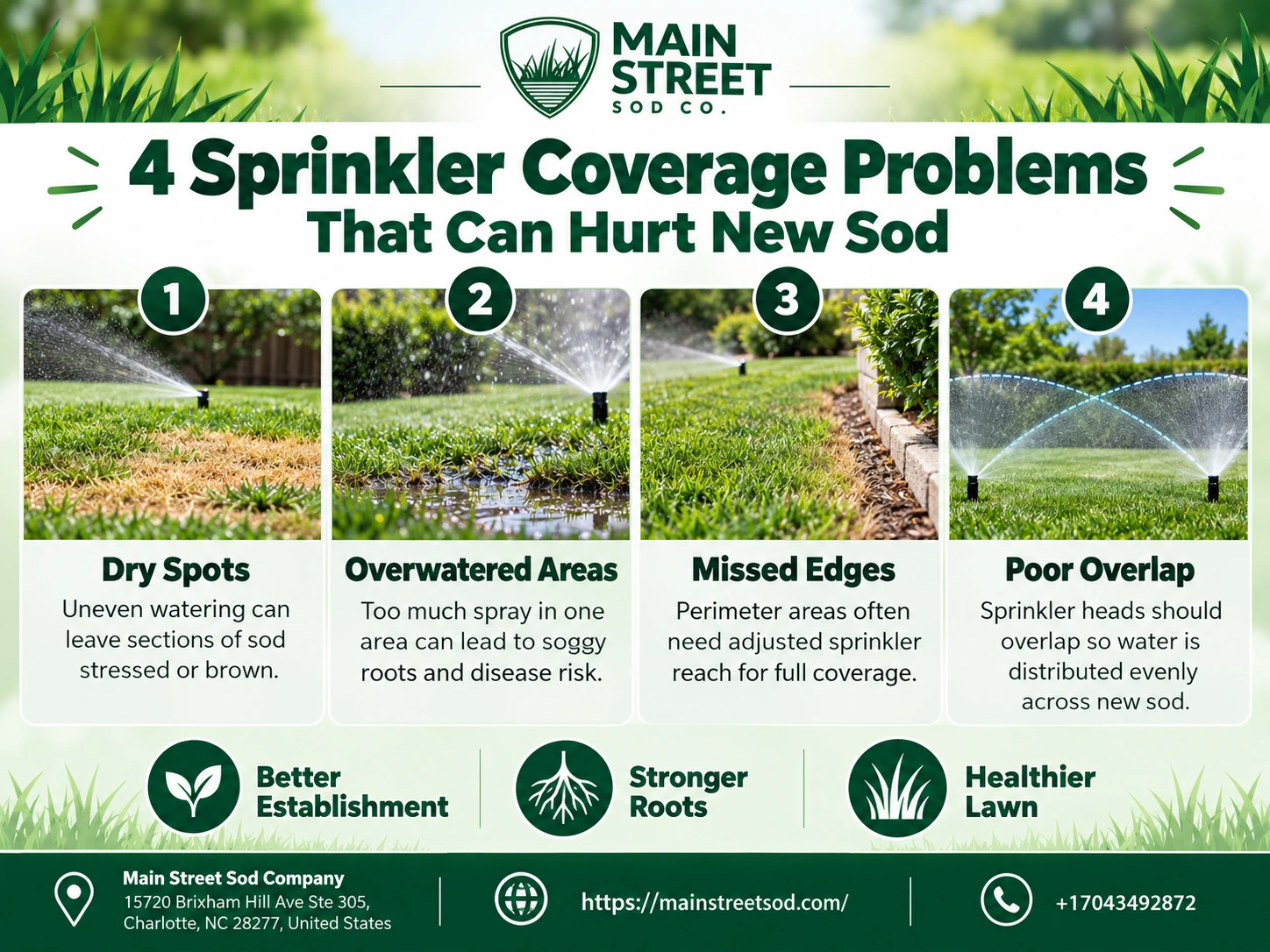
How Can You Correct Areas That Are Not Getting Enough Water?
Begin by determining why the area is dry. Avoid automatically increasing the runtime for every sprinkler zone because that can overwater sections already receiving enough moisture.
Observe the affected zone during operation.
A minor sprinkler adjustment may correct a spray pattern that stops short of the dry area. A blocked or malfunctioning head may need cleaning, repair, or replacement by someone qualified to perform the work.
Temporary supplemental watering may help protect a dry section while the irrigation problem is being corrected.
Apply water carefully and focus on the affected area rather than repeatedly soaking the entire lawn. The objective is to maintain suitable moisture during establishment without creating standing water or excessive runoff.
Continue monitoring the corrected section.
Color alone may not change immediately, so check moisture beneath the sod and watch for continued stress. If the area repeatedly dries despite sprinkler adjustments, factors such as soil conditions, slope, heat exposure, or system design may require further evaluation.
Can Too Much Water Damage New Sod?
Yes. New sod needs dependable moisture, but excessive watering can create poor establishment conditions.
Soil that remains saturated for prolonged periods may have less available oxygen around developing roots. Extremely wet areas can also become soft, muddy, or unstable.
Standing water is an obvious warning sign.
Water collecting on the lawn after irrigation may indicate that the application rate is faster than the soil can absorb, the watering period is too long, drainage is poor, or multiple sprinklers are concentrating water in the same location.
Overwatering can also make it difficult to judge whether the irrigation system has good coverage. A homeowner may continue increasing watering because one area remains dry while another receives far more water than necessary.
New sod should remain appropriately moist during establishment, not continuously flooded.
Conditions vary with sod type, weather, soil, drainage, sun exposure, and irrigation performance. Monitor the actual lawn rather than relying only on a fixed timer setting.
How to Water New Sod Without Causing Runoff
Water should have enough opportunity to soak into the soil rather than flowing away across the surface.
Runoff is more likely on slopes, compacted soils, and locations where sprinklers apply water faster than the ground can absorb it.
Watch the lawn while irrigation operates.
If water begins moving across sidewalks, driveways, or lower sections of the property, continuing the same watering cycle may waste water without improving root zone moisture.
Shorter watering periods separated by absorption time may help in conditions where runoff develops quickly. The appropriate approach depends on the irrigation system and site.
Sprinkler direction also matters.
Water landing primarily on pavement cannot contribute meaningfully to sod establishment. Adjusting spray patterns can keep more irrigation within the intended lawn area.
Check moisture after watering rather than assuming a longer cycle is better.
Efficient irrigation places sufficient water where roots need it while minimizing pooling, unnecessary overspray, and water leaving the lawn.
When Should Sprinkler Heads or Zones Be Adjusted?
Sprinkler heads or zones should be evaluated when coverage tests show consistent dry areas, excessive overlap, overspray, or major differences in water distribution.
Adjustment may also be needed after new sod changes the effective height around existing sprinkler heads.
A head sitting too low may have its spray blocked by grass. A tilted sprinkler can distribute water unevenly. Incorrectly directed heads may water pavement, landscaping, or structures instead of the sod.
Do not focus only on individual heads.
A larger coverage problem may involve pressure, sprinkler spacing, nozzle selection, or zone design. Adjusting one component without understanding the broader system can simply move the dry area somewhere else.
Observe results after every meaningful change.
Repeat the container test when necessary and compare previously dry locations with the rest of the zone.
The goal is balanced distribution across the new lawn, not maximum water output from each sprinkler.
When Is Professional Irrigation Help Needed?
Professional irrigation help may be appropriate when simple observations and minor adjustments do not correct uneven coverage.
Persistent dry zones, low pressure, damaged components, leaking lines, inconsistent zone performance, or widespread overspray can indicate a system problem requiring closer evaluation.
Professional assistance can also be useful before or immediately after a large sod installation.
An irrigation system that performed adequately for an older lawn may still have coverage weaknesses that become obvious when newly installed sod requires consistent moisture.
Complex changes should not be approached through repeated guesswork.
An irrigation professional can evaluate system operation, distribution, pressure, sprinkler placement, and other factors that influence coverage.
Sod and irrigation work are closely connected during establishment. Correcting distribution problems early can protect the investment in the new lawn and reduce the risk that individual sections decline because their watering needs are not being met.
FAQs
How do I know whether my sprinklers are covering new sod evenly?
Place identical containers throughout each irrigation zone and compare the amount of water collected during a measured watering period. Also inspect soil moisture and watch the sprinklers operate for visible gaps, overspray, or blocked patterns.
Should every part of new sod receive the same amount of water?
The goal is consistent moisture throughout the installation, although site conditions can cause individual areas to dry at different rates. Edges, slopes, sunny sections, and sod near pavement may require closer monitoring.
Why is one section of my new sod turning brown?
Uneven sprinkler coverage is one possibility, but browning can have several causes. Check moisture beneath the affected sod, sprinkler performance, soil contact, drainage, and surrounding conditions before assuming the problem is simply insufficient watering.
Can I hand water dry areas of new sod?
Careful supplemental watering can help protect isolated dry areas while a coverage problem is corrected. Avoid using supplemental watering as a permanent substitute for fixing an irrigation system that consistently misses part of the lawn.
How can I tell whether new sod is getting too much water?
Standing water, persistently saturated soil, muddy areas, or excessive runoff can indicate that irrigation needs adjustment. Evaluate both watering duration and distribution because excessive overlap can make one section much wetter than another.
Should irrigation coverage be checked before sod installation?
Yes. Testing the system before installation can reveal damaged heads, weak coverage, overspray, and other problems before the new sod depends on that system. Coverage should be checked again after installation because conditions around sprinkler heads may have changed.
Give New Sod the Coverage It Needs to Establish
Successful sod installation depends on more than placing healthy grass over prepared soil. Reliable sprinkler coverage helps protect that investment while the new lawn develops its root system. At Main Street Sod, we want our customers to understand how watering patterns, dry areas, runoff, and irrigation performance can affect establishment.
We can help identify sod related concerns and explain what a newly installed lawn needs during its establishment period. If you are planning a new lawn or have questions about how your sod is establishing, contact us to discuss the conditions and appropriate next steps.
Key Takeaways
Even sprinkler coverage gives new sod consistent moisture while roots begin establishing in the soil below. Dry zones can develop from blocked heads, poor overlap, wind, pressure problems, slopes, heat, or site conditions, while excessive irrigation can cause saturation and runoff. Homeowners should observe sprinkler operation, compare water distribution across each zone, and check soil moisture instead of relying only on timer settings. Correcting coverage problems early protects developing grass. When persistent irrigation problems cannot be resolved through basic adjustments, professional evaluation can help identify the underlying cause.