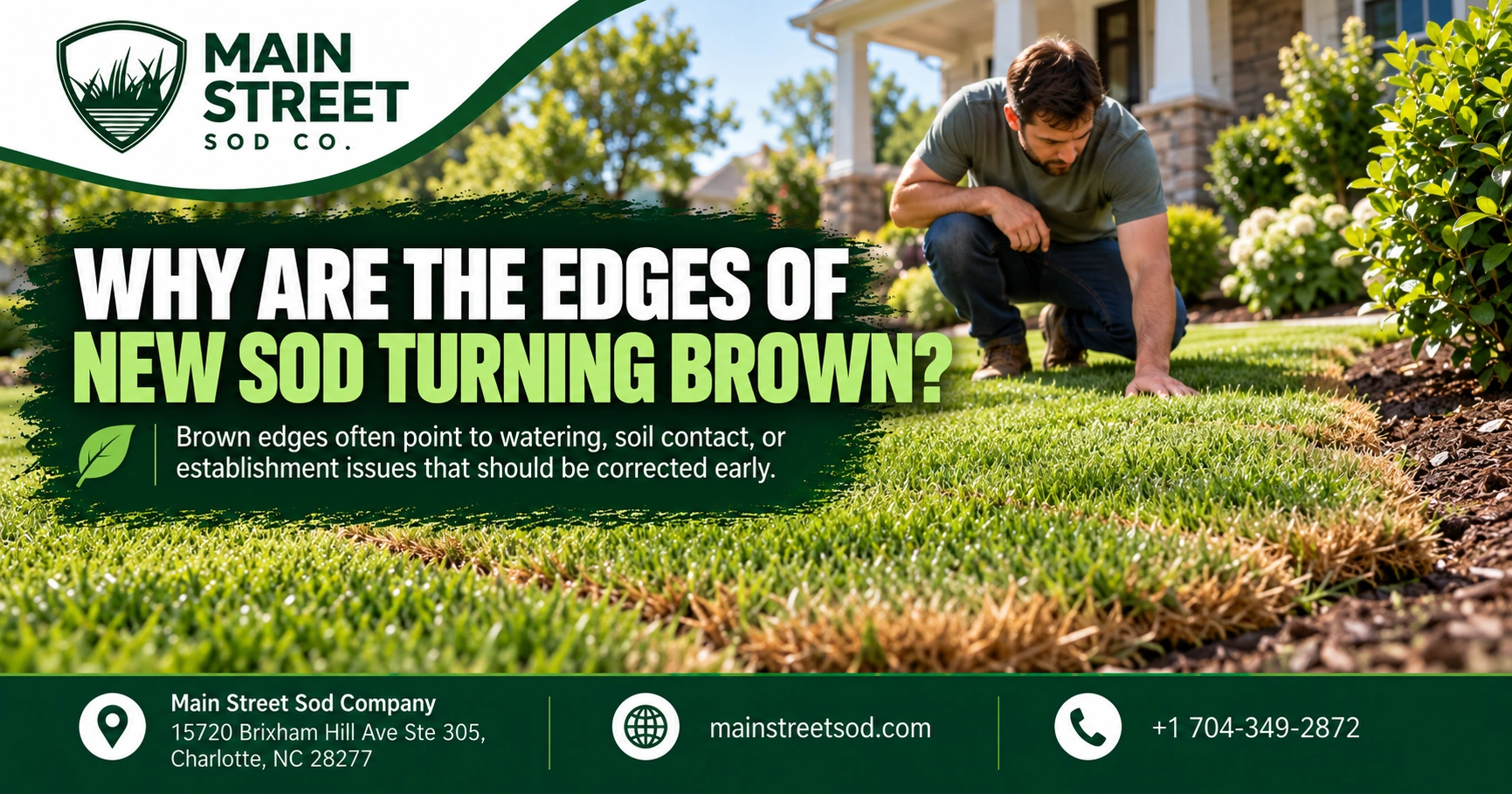
If the centers of your new sod pieces are green but the edges or seams are turning brown, those areas are often drying faster than the rest of the lawn.
Sod edges are more exposed to air, sun, heat, and wind. They also contain less surrounding moist turf to protect them from moisture loss. Small gaps between pieces, uneven sprinkler coverage, poor contact with the soil underneath, or hot pavement nearby can make the problem worse.
Brown edges do not automatically mean the sod is dead. Grass that has dried but still has living crowns and roots may recover once the moisture problem is corrected. However, crispy turf that continues deteriorating, sod that never begins rooting, or browning that spreads across entire pieces can indicate a larger establishment issue.
The most useful first step is to determine whether the problem is limited to seams and exposed edges or affecting the lawn more broadly.
Homeowners preparing for a new lawn can also review Main Street Sod’s sod installation services for information about professional soil preparation, placement, and establishment.
Why Are the Edges of New Sod Turning Brown?
Brown sod edges usually indicate that those narrow areas are experiencing more stress than the centers of the pieces.
Moisture loss is one of the most common reasons.
Fresh sod has a shallow, recently cut root system. Until those roots grow into the soil underneath, the grass depends heavily on moisture held within the sod layer and upper soil.
If an edge begins drying, it has very little moisture reserve.
Main Street Sod notes that underwatered new sod may curl, fade, develop dry edges, turn brown, or shrink at the seams. The company also identifies poor soil contact and improper gaps between sod pieces as establishment problems that can contribute to uneven growth.
A few brown seam lines therefore do not necessarily mean the entire watering program is wrong.
They may mean certain areas are receiving less water, losing it faster, or failing to maintain good contact with the soil.
Before increasing irrigation everywhere, inspect the pattern closely.
Why Do Sod Edges Dry Out Before the Centers?
The middle of a sod piece is protected on all sides by surrounding turf and soil.
The edge is exposed.
Air can move across it more easily, sunlight can reach the side of the sod, and moisture can evaporate from a larger exposed surface. If the edge curls upward even slightly, more of the soil layer beneath the grass becomes exposed.
That creates a cycle.
The edge dries, begins to shrink or curl, loses some contact with the soil, and then dries even faster.
Penn State Extension specifically cautions that sod strips should fit tightly because spaces left between pieces allow the sod to dry quickly and slow the knitting together of adjacent strips.
Outer lawn boundaries can be particularly vulnerable.
Sod beside a driveway, sidewalk, curb, patio, or bare soil has no neighboring piece protecting that exposed side. Hardscape can also become hot in direct sun and create a harsher microclimate along the lawn edge.
That is why the pattern matters. Narrow brown lines tracing seams or pavement often point toward localized moisture stress rather than a problem affecting every part of the sod equally.
Can Uneven Watering Cause Brown Sod Edges?
Yes.
A sprinkler may appear to be covering the entire lawn while still leaving weaker zones between spray patterns, around corners, beside buildings, or along outer edges.
New sod is especially sensitive to those small coverage differences.
During early establishment, Iowa State Extension recommends keeping both the sod and the soil beneath it moist and notes that warm conditions may require additional watering. Once the sod begins rooting, irrigation can gradually become deeper and less frequent.
If only the seams are browning, do not assume the solution is simply running every irrigation zone much longer.
Instead, check actual coverage.
Place several shallow containers or rain gauges in green areas and brown-edge areas, then run the irrigation system. Significant differences can reveal missed spots or uneven distribution.
You can also gently inspect the soil beneath a browning edge and compare it with the center of a healthy piece.
If the seam area is noticeably drier, targeted hand watering may make more sense than saturating the entire lawn.
Main Street Sod emphasizes that new sod needs consistent moisture rather than constant flooding. Both under- and overwatering can interfere with rooting.
How Do Gaps Between Sod Pieces Affect Moisture?
Gaps expose more of the sod edge to drying.
Properly installed pieces should fit closely against one another without being stretched or overlapped.
Iowa State Extension warns that stretching sod can lead to gaps as the pieces dry. Penn State similarly recommends fitting edges tightly because open spaces allow rapid drying and slower establishment between strips.
Even a relatively small seam can matter during hot, dry weather.
Exposed soil between rolls heats and dries faster than soil protected beneath the sod. The adjacent turf edges can then lose moisture from both the top and side.
The sod may also shrink slightly when it becomes too dry, making the gap wider and increasing moisture loss further.
University of Minnesota Extension recommends filling cracks between sod pieces with soil to help prevent the edges from drying.
Do not try to solve an established gap by pulling or stretching rooted sod across the opening.
If noticeable gaps were left during installation, the appropriate correction depends on their size, how long the sod has been down, and whether the pieces have started rooting.
Can Heat and Wind Dry Out Sod Edges Faster?
Yes. Hot, sunny, or windy conditions can increase moisture loss substantially.
Fresh sod begins losing moisture as soon as it is harvested. Main Street Sod notes that exposure to air and sun dries sod quickly and that heat increases stress before the turf is fully established.
After installation, the exposed edges remain the most vulnerable portions.
Wind continually replaces the humid air directly above the turf with drier air, increasing evaporation. Strong sun heats the sod and soil surface. Warm pavement beside the lawn can add additional heat.
Those effects become more noticeable when several conditions occur together.
A seam that stays adequately moist on a mild, cloudy day may dry surprisingly quickly during hot sun and wind.
That does not mean homeowners should automatically flood the lawn during every hot period.
Check moisture first. If the soil is already saturated, more water may create a different establishment problem.
The goal is to keep newly installed sod consistently moist enough to support rooting while responding to weather changes rather than relying on the same irrigation duration under every condition.
Does Poor Soil Contact Cause Edge Browning?
It can.
Sod roots need direct contact with the prepared soil underneath them.
If a section bridges over a low spot, contains an air pocket, or curls upward at a seam, its roots may have less access to moisture in the underlying soil.
Main Street Sod identifies poor soil contact as a major reason new sod struggles to establish. Uneven, compacted, or debris-filled ground can prevent roots from connecting properly with the soil below.
Good installation practices are intended to reduce those problems.
University of Minnesota Extension recommends rolling newly laid sod to ensure good root-to-soil contact, while Penn State advises rolling or lightly tamping the installed turf before establishment.
If a brown edge lifts easily while nearby turf is firmly attached, poor contact or slower rooting may be contributing.
Do not repeatedly lift healthy pieces to inspect them, however.
A gentle check near a problem seam is enough. Once roots begin attaching, repeated pulling can disturb the establishment you are trying to protect.
Can Brown Sod Edges Recover?
Sometimes.
Brown does not always mean dead.
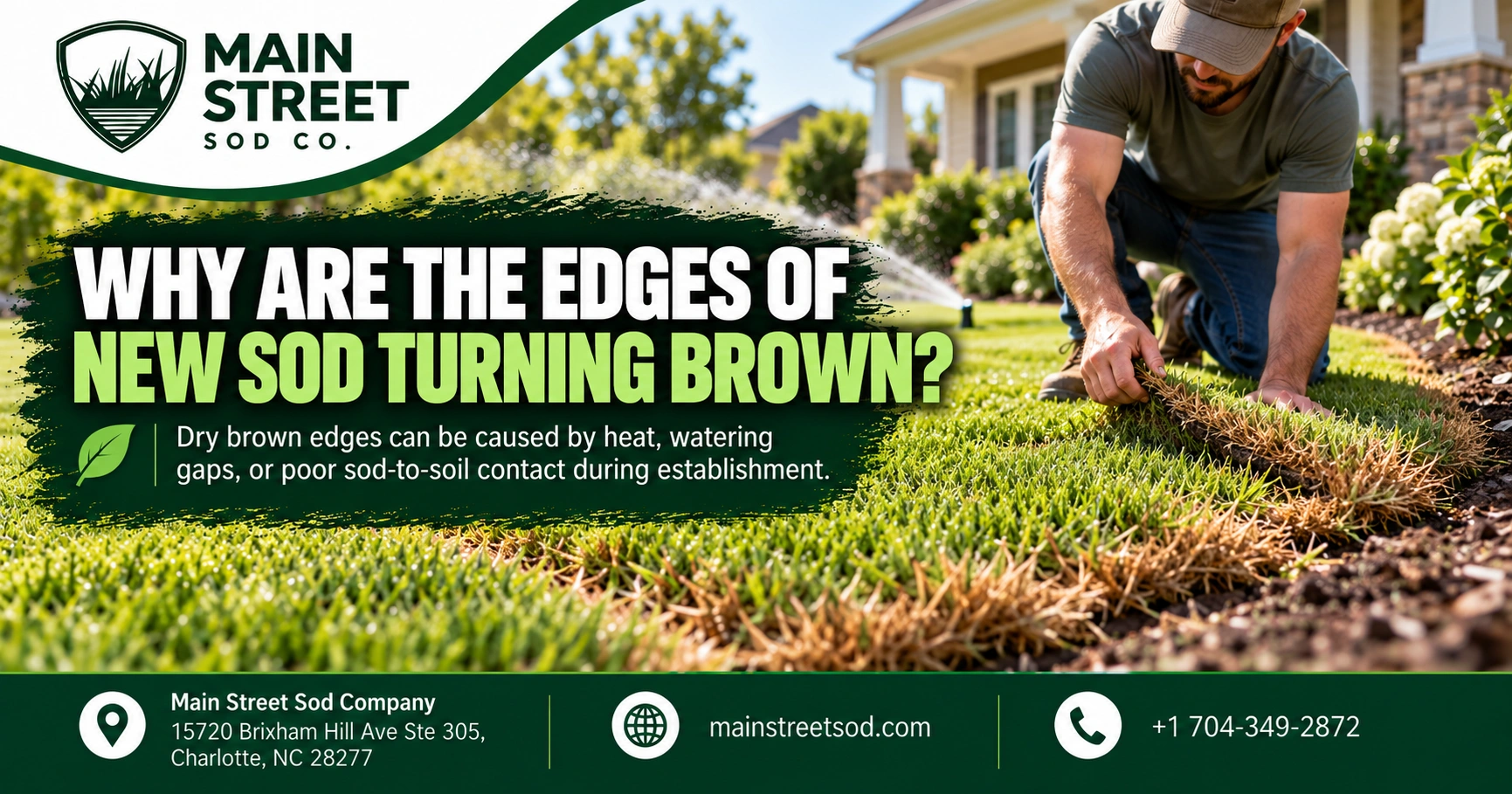
Grass blades can lose color after moisture stress while the crown and roots remain alive. If those growing points survive and the underlying problem is corrected promptly, new green growth may appear.
An Extension response to browned new sod notes that recovery depends on whether drying affected only the foliage or also damaged the crowns and roots.
That distinction explains why two brown-looking seams can have different outcomes.
A lightly browned edge that remains somewhat flexible and begins rooting may recover.
An edge that is completely dry, brittle, severely shrunken, and detached from the soil has a poorer chance.
Give stressed turf time to respond after correcting moisture or contact problems rather than judging it immediately after one watering.
Look for new growth from the base and improved attachment to the soil.
If the brown section continues expanding despite appropriate moisture, or the turf shows no signs of new growth, the damaged portion may eventually need repair or replacement.
How Can You Help Dry Sod Edges Recover?
First, identify whether the edge is actually dry.
Check the soil beneath the affected area and compare it with a healthy portion nearby.
If the seam is dry while the rest of the lawn has adequate moisture, concentrate on improving coverage in that area rather than dramatically increasing water across the entire lawn.
Targeted hand watering can help dry seams during establishment.
If a small gap exposes soil between pieces, appropriate soil may be used to fill the opening and reduce additional drying, consistent with Extension recommendations for cracks between sod strips.
Make sure curled edges maintain contact with the soil rather than remaining suspended above it.
Also keep unnecessary traffic away from the stressed area. Newly installed sod needs stable soil contact, and repeated walking can shift pieces before roots establish.
Then monitor rather than constantly changing the treatment.
A stressed edge needs time to produce fresh growth.
For broader information about irrigation, mowing, and fertilization after installation, Main Street Sod’s sod maintenance guide is the more appropriate resource.
When Is Browning a Sign of a Bigger Sod Problem?
The pattern provides important clues.
Thin brown lines limited mostly to seams suggest localized drying or installation gaps.
Browning that spreads through the centers of many pieces deserves a broader investigation.
Check for consistently dry soil, standing water, poor rooting, severe heat stress, drainage problems, or signs that the sod was already stressed before installation.
Overwatering can also create unhealthy turf.
Main Street Sod warns that saturated soil can reduce oxygen around developing roots and interfere with establishment.
A recent Extension case involving broadly browned new sod also illustrates why widespread discoloration cannot always be diagnosed as simple drought; insufficient rooting, heat stress, turf type, and disease can produce overlapping symptoms.
Look more closely when:
- Browning is spreading rapidly across whole pieces.
- The soil remains constantly soggy.
- Sod smells abnormal or appears to be rotting.
- Large sections still lift easily well into the establishment.
- Water consistently pools in particular areas.
- Browning continues even after irrigation coverage is corrected.
- Only certain areas repeatedly fail to root.
Those patterns may justify having the installation, irrigation, soil, or turf condition evaluated instead of continuing to add more water.
How Can You Prevent Edge Browning After Installation?
Prevention begins during installation.
Sod should be installed promptly, fitted closely together, and placed on properly prepared soil. Tight seams reduce exposed edges, while good soil contact helps developing roots access moisture below the sod.
Main Street Sod emphasizes correct seam alignment, timely installation, prepared soil, immediate watering, and good soil-to-sod contact as important parts of successful installation.
After installation, verify irrigation coverage rather than assuming every area receives the same amount.
Pay extra attention to:
- Outer lawn edges
- Narrow strips
- Corners
- Slopes
- Areas beside driveways or sidewalks
- Sections exposed to strong afternoon sun
- Spots affected by wind
- Connections between irrigation zones
Weather should influence monitoring too.
A mild cloudy day and a hot windy afternoon do not create the same moisture demand.
At the same time, avoid keeping the lawn continuously waterlogged. As roots establish, watering should gradually transition from frequent surface moisture toward deeper, less frequent irrigation appropriate for the turf, soil, and weather.
Main Street Sod provides professional sod installation throughout its service region, with proper soil preparation, placement, and establishment forming important parts of the installation process. Homeowners can also review Main Street Sod’s service areas for local availability.
FAQs
Are brown seams in new sod normal?
A small amount of edge stress can occur, particularly during hot or dry conditions, but noticeable brown seams should be checked rather than ignored. They commonly point to faster moisture loss at exposed edges, gaps, or uneven irrigation coverage.
Should I water brown sod edges more?
If the affected edges are actually drier than the healthy centers, targeted watering may help. Check the soil first. If the lawn is already saturated, adding more water everywhere can interfere with rooting instead of solving the problem.
Why is my new sod green in the middle but brown around every piece?
That pattern strongly suggests the edges are losing moisture faster than the centers. Open seams, sprinkler coverage, heat, wind, and inadequate soil contact should be checked first. Extension guidance specifically warns that gaps between sod pieces allow the edges to dry rapidly.
Will gaps between sod eventually fill in?
Small seams may become less visible as established turf grows, depending on the grass type. However, gaps should not be intentionally left during installation. Open spaces increase drying and can slow knitting between pieces.
How do I know whether a brown sod edge is dead?
Appearance alone cannot always confirm it. Lightly stressed grass may brown while its crown and roots remain alive. Look for new growth and rooting after moisture conditions are corrected. Completely brittle turf with dead crowns and roots has much less recovery potential.
When should I call someone about browning new sod?
Consider professional evaluation when browning spreads beyond the edges, large sections remain loose, water pools or drainage appears poor, the lawn stays saturated, or stressed areas continue worsening despite appropriate watering.
If the problem is limited to seams, begin with moisture coverage, gaps, and soil contact. When the entire lawn is declining, broaden the diagnosis instead of treating every brown area as underwatering.
Main Street Sod helps homeowners throughout communities in North and South Carolina with sod installation and establishment. You can explore the company’s service areas or sod installation services if your lawn needs professional evaluation or replacement planning.