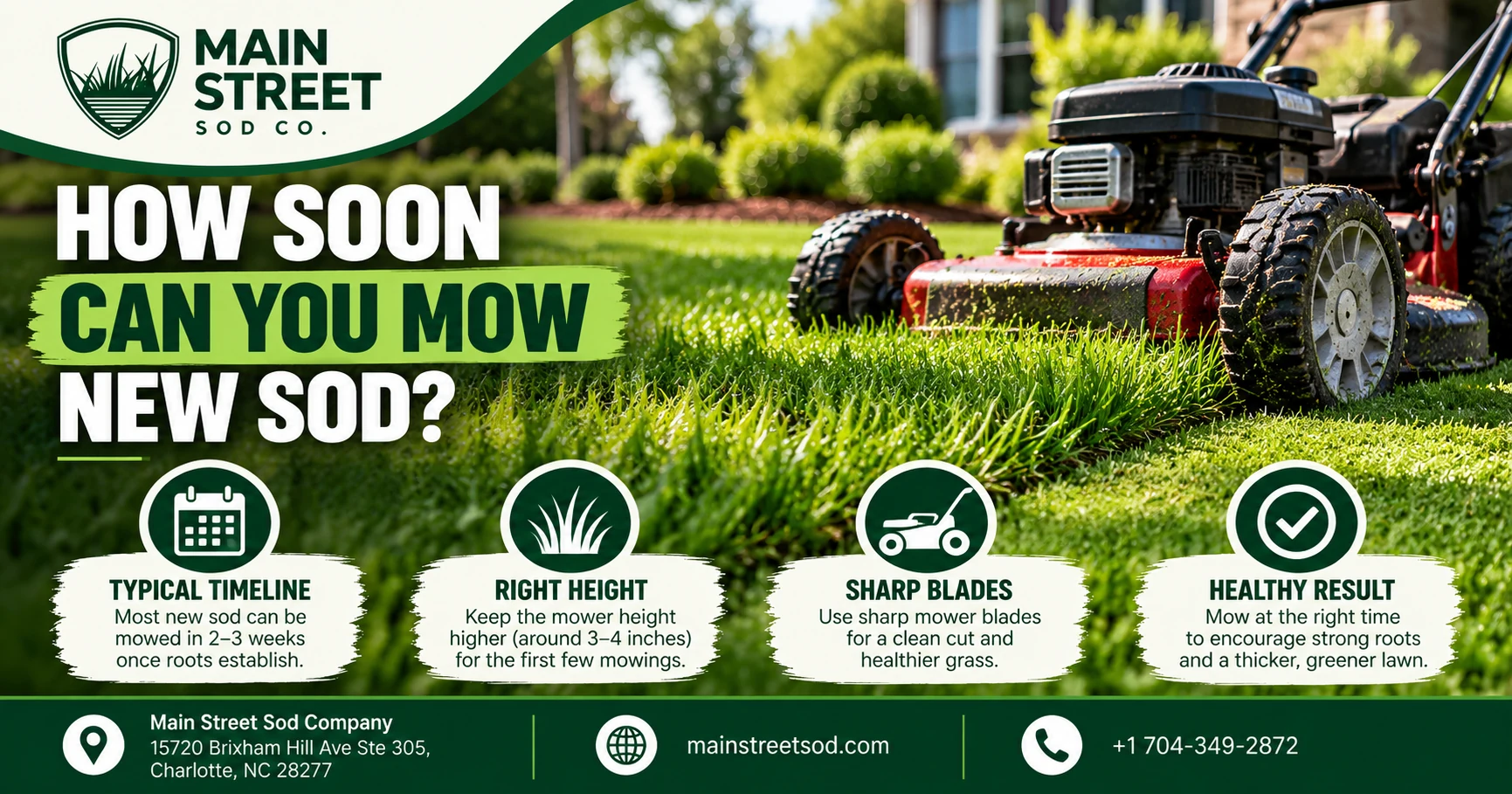
You should mow new sod only after it has rooted firmly enough that the mower will not lift, shift, or wrinkle the turf. For many lawns, early rooting begins around 10 to 14 days after installation, but the calendar alone should not determine when you mow. Weather, grass type, soil conditions, watering, and installation quality can all change how quickly sod establishes.
Before the first mowing, gently test a few sections of sod. If the turf resists a light pull and the soil is firm enough to support the mower without leaving ruts, the lawn may be ready. If pieces still lift easily or the ground feels soft and saturated, wait longer.
The first cut should also be conservative. Use the recommended mowing height for your grass type and avoid removing more than about one-third of the grass blade at one time. NC State Extension recommends following that one-third rule to reduce stress on turf.
If you are still planning your lawn, Main Street Sod’s sod installation services can help with professional installation and early-care guidance.
How Soon Can You Mow New Sod?
There is no single number of days that works for every new lawn.
Main Street Sod notes that many newly installed lawns begin developing shallow roots within approximately 10 to 14 days, with fuller establishment taking several additional weeks. However, temperature, rainfall, irrigation, soil type, grass variety, and site preparation can all affect that timeline.
Clemson Extension recommends waiting until newly installed sod is firmly rooted and securely in place before mowing.
That distinction matters.
A lawn may look tall enough to mow before the roots have attached well to the soil beneath it. Mowing simply because the grass looks long can cause sections to move, especially when the mower turns or passes over seams.
Instead of asking only, “How many days has it been?” ask:
- Does the sod resist a gentle pull?
- Does the lawn stay flat when lightly walked on?
- Is the soil firm instead of soggy?
- Has the grass produced noticeable new growth?
- Can the mower cross the surface without sinking or creating ruts?
If those conditions are not met, give the sod more time to establish.
What Signs Show New Sod Is Ready to Mow?
The most important sign is root attachment.
Newly installed sod initially sits on top of the prepared soil like a layer of carpet. As roots begin growing downward, the turf becomes increasingly anchored to the ground.
Main Street Sod identifies several signs of successful rooting, including resistance when the sod is gently lifted, fresh blade growth, a fuller appearance, and better tolerance of normal moisture changes.
Before mowing, look for:
- Sod that stays firmly against the soil
- Resistance during a gentle pull test
- Upright, actively growing grass
- Seams that are beginning to look less noticeable
- Soil firm enough to support light foot traffic
- No large loose or curling sections
Do not rely only on grass height.
Fast-growing sod may become tall before roots are strong enough to hold the turf securely. Conversely, slower growth during cooler conditions may delay both rooting and the need to mow.
The lawn should meet both requirements: the grass needs cutting, and the sod needs enough root attachment to tolerate mowing.
How Can You Check Whether the Sod Has Rooted?
Use a gentle pull test.
Choose a few areas around the lawn rather than checking only one spot. A corner or seam is usually easiest to test.
Gently lift or tug the sod with your fingers.
Freshly installed sod will usually lift easily because the roots have not connected to the soil underneath. As establishment progresses, the turf should resist being lifted.
University of Minnesota Extension recommends checking sod after roughly 10 to 14 days by gently tugging several areas. Resistance indicates that roots are growing into the soil.
Main Street Sod gives similar guidance: when a gentle tug meets resistance, root establishment is underway.
Do not repeatedly pull the same sections after they begin rooting. The purpose is to confirm attachment, not disturb developing roots.
Also check different parts of the lawn.
Areas along pavement, slopes, edges, shaded locations, or spots receiving uneven irrigation may establish at different rates. If large sections are still loose, waiting before mowing is usually safer than mowing only because another portion has rooted.
What Height Should You Use for the First Mow?
Use the recommended mowing height for the specific grass variety rather than cutting new sod unusually short.
Different turfgrasses perform best at different heights, so there is no universal first-mow setting for every lawn.
NC State Extension recommends mowing based on turf type and cutting often enough that no more than one-third of the total leaf surface is removed at one time.
For example, if the desired mowing height is 3 inches, the lawn generally should not be allowed to become much taller than about 4.5 inches before cutting it back to 3 inches.
If the new sod has become excessively tall while you wait for rooting, do not scalp it in one mowing.
Raise the mower deck and remove a smaller amount first. Then gradually return to the normal recommended height over later mowings.
Scalping can remove too much green leaf tissue at once and place unnecessary stress on a lawn that is still establishing roots.
A sharp mower blade is also important. Dull blades tear grass rather than cutting it cleanly and can make a newly mowed lawn look ragged or brown at the tips.
Should You Water Before or After Mowing New Sod?
Avoid mowing when the sod and soil are heavily saturated.
New sod needs consistent moisture while roots establish, but excessively wet soil can be too soft to support a mower. Mowing under those conditions may create ruts, compact the soil, or cause pieces of sod to shift.
Main Street Sod recommends keeping new sod consistently moist during early establishment while avoiding constantly saturated soil. Watering should gradually become deeper and less frequent as roots develop.
Before the first mowing, allow the grass blades to dry enough for clean cutting and make sure the soil surface is reasonably firm.
That does not mean intentionally allowing new sod to dry out.
If watering is due, mow when the surface conditions are appropriate and then resume the recommended irrigation schedule afterward.
Early morning is commonly preferred for normal lawn irrigation because it reduces evaporation compared with hotter parts of the day.
For broader watering, mowing, and fertilization guidance after installation, see Main Street Sod’s sod maintenance guide.
What Mowing Mistakes Can Damage New Sod?
The first mowing is not difficult, but several common mistakes can place unnecessary stress on the lawn.
The first is mowing before roots have established.
A mower can shift loose pieces, open seams, or pull sections away from the soil.
The second is mowing when the soil is too wet. Heavy equipment crossing soft ground can create depressions and ruts.
Another mistake is cutting the grass too short.
Homeowners sometimes let new sod grow tall while waiting for rooting, then try to restore the normal height in one pass. Removing too much leaf material at once can stress the turf.
Other mistakes include:
- Using a dull mower blade
- Making aggressive turns on newly rooted sod
- Repeatedly mowing the same path
- Using unnecessarily heavy equipment
- Scalping high areas
- Mowing immediately after heavy watering or rain
- Ignoring loose sections before starting
For the first few cuts, gentle mower movements are especially helpful.
Wide, gradual turns place less sideways force on the turf than sharp turns, which can twist or displace sections that are still strengthening their roots.
Can Mowing Too Early Pull Up the Sod?
Yes.
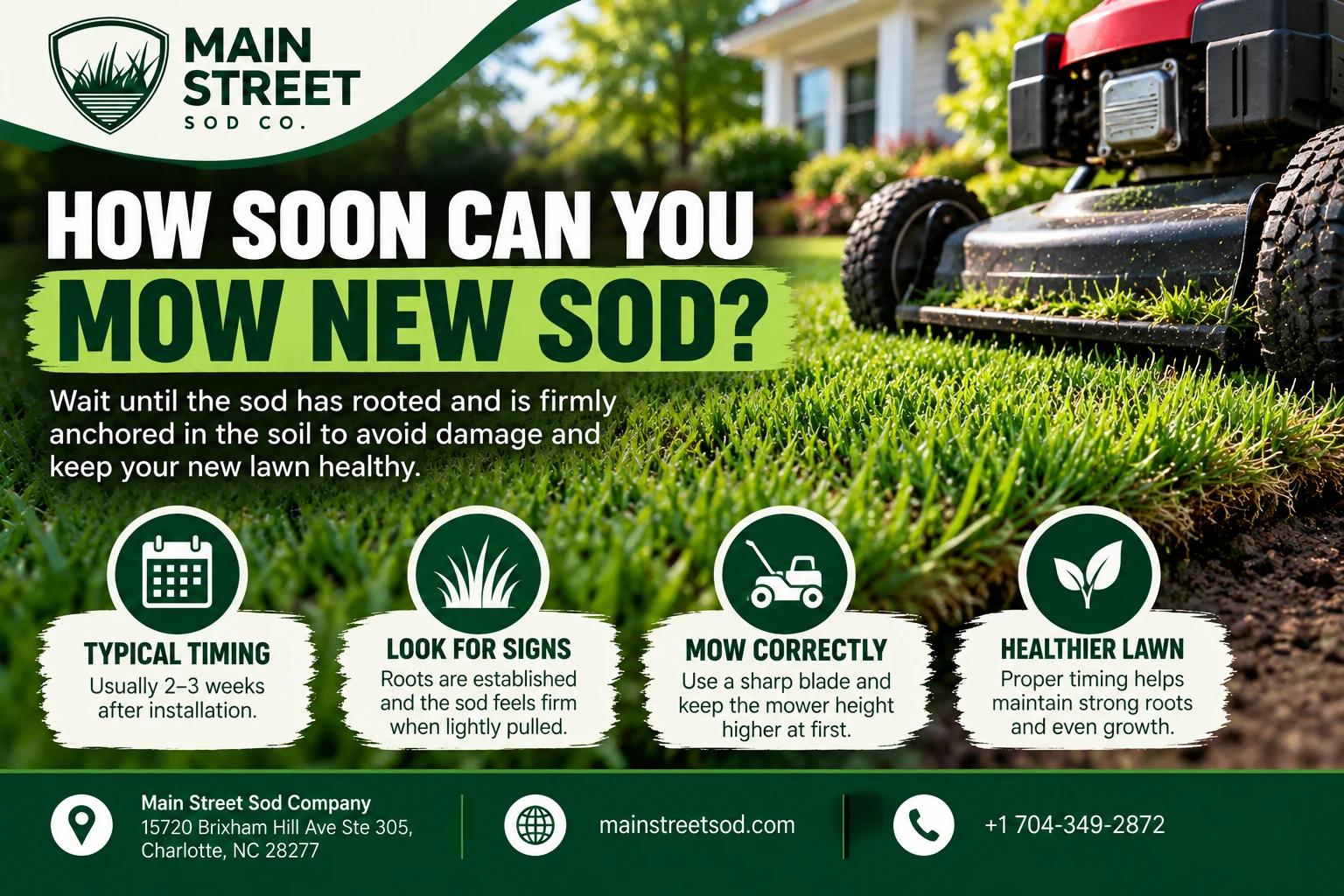
Before roots grow into the underlying soil, individual pieces of sod can still move. A mower creates both downward pressure and sideways force as it travels and turns.
If the turf is loose, wheels may push or wrinkle a piece. A sharp turn may pull at a seam. In extreme cases, part of the sod may lift.
That is why root attachment is more important than following a fixed day count.
Main Street Sod specifically advises waiting until the sod is sufficiently rooted that mowing will not shift or lift it and until the soil is firm enough to support the mower without rutting.
If you notice a section move during the first mowing, stop and inspect the area rather than continuing over it.
Loose pieces may indicate slower rooting, excessive moisture, poor soil contact, or uneven establishment.
Waiting several more days is usually preferable to repeatedly disturbing a section that is trying to root.
How Much Grass Should You Remove on the First Cut?
Try not to remove more than one-third of the grass blade during the first mowing.
This is not a rule specific only to sod. It is a standard turf-management practice designed to avoid removing too much photosynthetic leaf tissue at once.
NC State Extension recommends mowing frequently enough that no more than one-third of the leaf surface is removed in a single mowing.
Suppose a grass variety is normally maintained at 2 inches.
If the sod has grown considerably beyond that height while rooting, do not automatically lower the mower directly to 2 inches.
Instead, make a higher first cut. After the lawn recovers and grows again, gradually lower the mowing height until you reach the recommended range for that turf type.
This approach is especially useful when weather or wet soil has delayed the first mowing.
The objective is to begin shaping the lawn into its normal maintenance routine without stressing newly established roots.
What Should You Do After the First Mowing?
After mowing, inspect the lawn.
Look for sections that moved, mower ruts, lifted seams, scalped spots, or areas that still feel unusually soft.
If the lawn remained stable, that is a good sign that the establishment is progressing.
Continue adjusting irrigation as roots deepen. Newly installed sod generally transitions from frequent early moisture toward deeper and less frequent watering as establishment improves. Main Street Sod emphasizes making that transition based on root development, weather, soil, and lawn condition rather than simply changing the sprinkler timer on a predetermined date.
Continue limiting unnecessary heavy traffic if the lawn still feels tender.
The first successful mowing does not mean the root system is fully mature. Main Street Sod notes that fuller establishment may take approximately four to six weeks or longer depending on conditions.
Keep monitoring color, growth, moisture, and attachment during that period.
When Can You Return to a Normal Mowing Schedule?
Begin transitioning to a normal mowing schedule once the sod is securely rooted, growing consistently, and tolerating mowing without shifting.
From that point, mowing frequency should be based primarily on growth rate and the recommended height for the turf variety.
Grass does not grow at the same rate every week.
Temperature, rainfall, irrigation, sunlight, fertility, season, and grass type all affect how frequently mowing is needed. NC State Extension recommends using grass growth rather than a rigid weekly calendar as the primary guide.
Continue following the one-third rule whenever practical.
If several rainy days prevent mowing and the lawn becomes too tall, raise the mower deck for the next cut rather than removing excessive growth at once. Gradually return to the normal height over subsequent mowings.
Main Street Sod serves homeowners throughout communities in North and South Carolina, including Rock Hill, Fort Mill, Charlotte-area communities, and surrounding service areas. Homeowners looking for installation help can review the company’s service areas or professional sod installation options.
FAQs
Can I mow new sod after one week?
Possibly, but seven days should not be treated as an automatic mowing date. Some sod may still be too loosely rooted at that point. Check whether the turf resists a gentle pull and whether the soil is firm enough for mowing before proceeding.
Is two weeks usually long enough before mowing new sod?
Many lawns begin showing noticeable root attachment around 10 to 14 days, so two weeks is a useful time to check readiness. However, slow rooting caused by weather, soil conditions, shade, excess moisture, or turf type may require additional time.
What happens if I mow sod before it roots?
Mowing too early can shift, wrinkle, or lift loose pieces of sod. Mower tires may also create ruts if the underlying soil remains wet and soft. Wait until the sod resists a gentle tug and feels secure.
Should new sod be dry before mowing?
The grass blades should be reasonably dry, and the soil should be firm enough to support the mower without sinking or rutting. Do not intentionally allow newly installed sod to become drought stressed just to mow it.
Should I bag the clippings on the first mow?
If the lawn is cut at the correct height and only a small amount is removed, short clippings can generally remain on the turf. NC State Extension notes that properly sized grass clippings can decompose and recycle nutrients rather than contributing significantly to thatch.
How do I know my new sod is fully established?
Firm root attachment, consistent new growth, improving tolerance of normal traffic, and the ability to transition toward deeper, less frequent irrigation are all signs of progress. Main Street Sod notes that fuller establishment often takes around four to six weeks, although weather, turf type, and site conditions can extend that timeline.
The safest answer to “how soon can you mow new sod?” is therefore not a fixed date. Wait until the lawn is rooted firmly, the ground can support the mower, and the grass has grown enough to need cutting. Then make a conservative first cut with a sharp blade and allow the lawn to transition gradually into its normal maintenance routine.
At Main Street Sod, proper installation and early aftercare are treated as part of establishing a healthy lawn, not separate steps. If you are preparing for new sod or want professional installation guidance, explore our sod installation services and service areas.