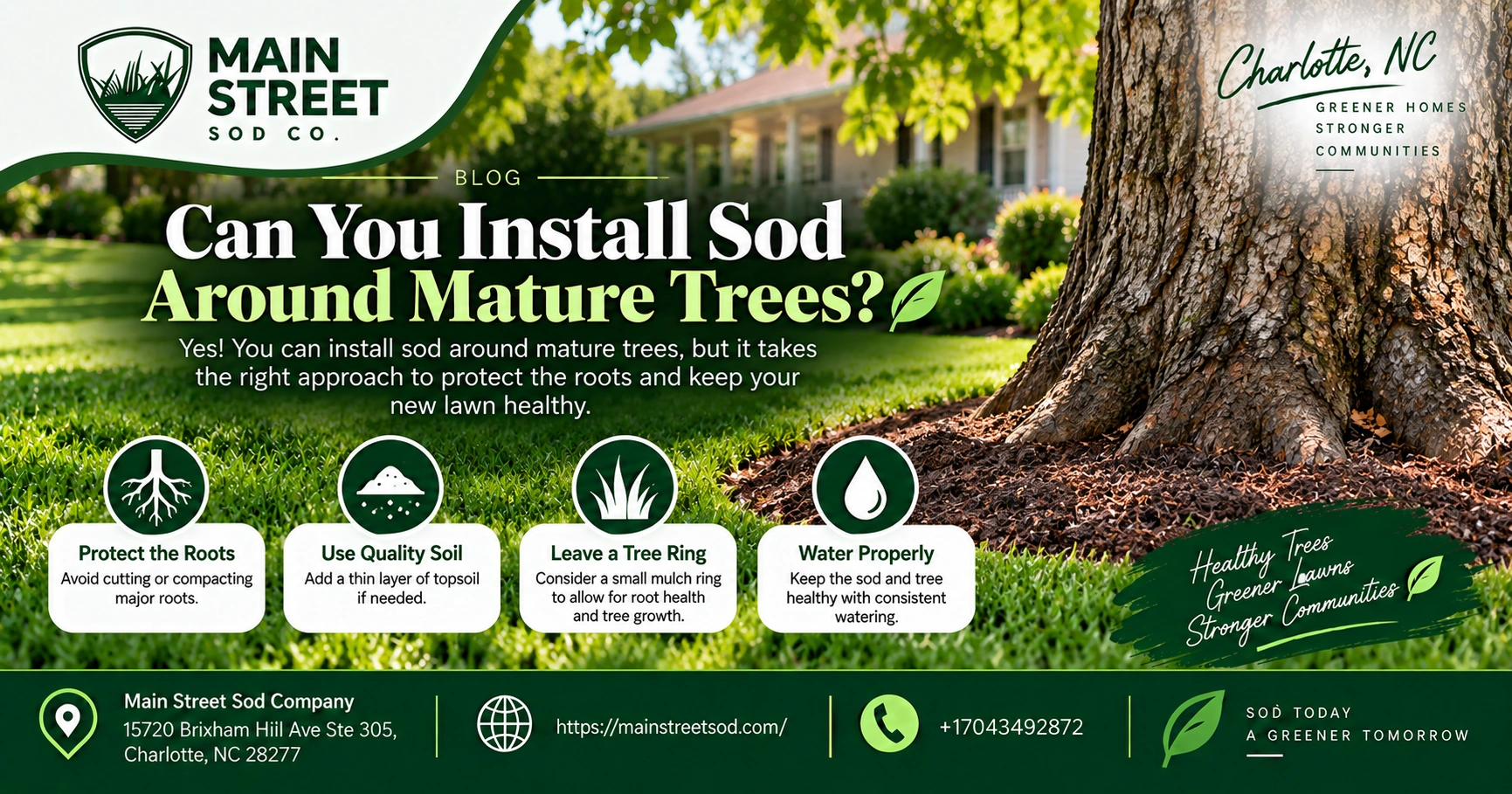
Yes, you can install sod around mature trees in some yards, but success depends on more than simply laying grass around the trunk. Mature trees can create heavy shade, compete with turf for water and nutrients, and leave dense roots close to the soil surface.
The most important question is whether the area provides enough sunlight, usable soil, moisture, and root space for grass to establish without damaging the tree.
If those conditions are reasonable, carefully selected sod can work around many mature trees. If the canopy creates deep shade or large surface roots occupy most of the available soil, forcing sod into the area may lead to thin grass and repeated replacement.
At Main Street Sod, we recommend evaluating the growing conditions first. Sometimes careful sod preparation and the right turf variety are enough. In more difficult areas, leaving additional space around the tree and using mulch or another suitable ground cover can be the more practical choice.
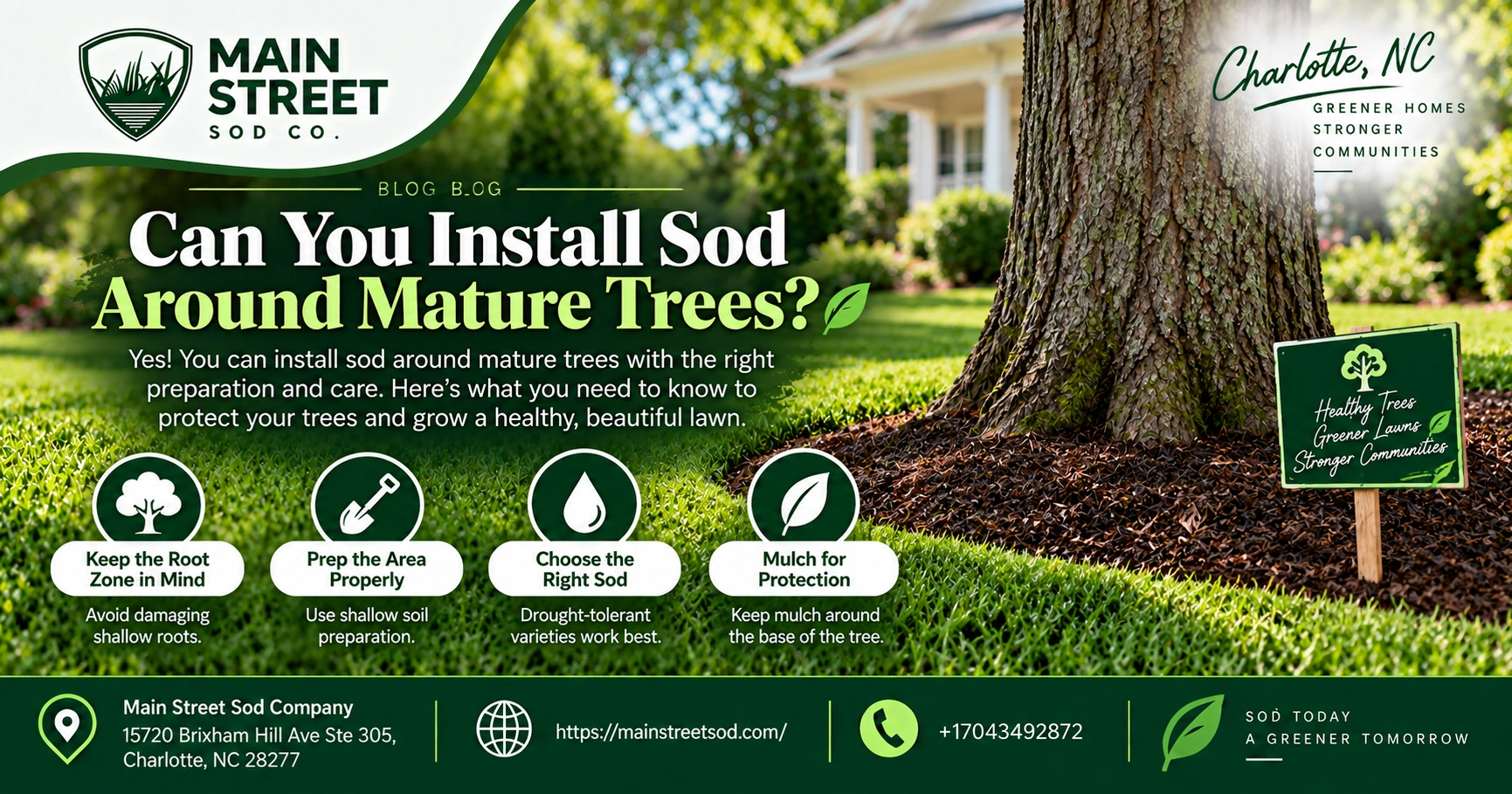
Can You Install Sod Around Mature Trees?
Sod can be installed near many mature trees, but not every part of the area beneath a tree canopy is necessarily suitable for turf.
Think of the tree and the grass as two plants sharing the same growing environment. Both need:
- Water
- Nutrients
- Oxygen in the soil
- Root space
- Adequate growing conditions
The tree already has an established root system and canopy, giving it a significant advantage over newly installed sod.
That does not mean grass will automatically fail. Lawns often grow successfully beneath trees where there is enough filtered sunlight and sufficient soil between major roots.
Problems become more likely when you have a combination of:
- Dense shade throughout most of the day
- Large roots at or above the surface
- Very dry soil beneath the canopy
- Compacted ground
- Poor irrigation coverage
- Thin soil around roots
- A turf variety with high sunlight requirements
Before ordering sod, evaluate those conditions rather than assuming bare ground beneath a tree simply needs new grass.
What Makes Sod Installation Around Mature Trees Difficult?
Areas beneath established trees can look like ordinary parts of the lawn, but their growing conditions are often very different.
The tree is already established
New sod starts with a relatively shallow root system.
A mature tree may have roots extending throughout the surrounding soil and is already capable of drawing moisture and nutrients from the area. Fresh sod has to be established in that existing root environment.
The soil can be difficult to prepare
Sod performs best when it makes consistent contact with prepared soil.
Around mature trees, large roots may interrupt the surface and make normal preparation more difficult. The goal should not be to remove roots simply to create a perfectly smooth lawn.
Tree health needs to remain part of the decision.
Shade changes throughout the property
A yard may receive strong sunlight away from the tree but considerably less beneath the canopy.
The difference can be significant enough that a turf variety performing well across the rest of the lawn becomes thin underneath the tree.
Water behaves differently beneath trees
The soil under mature trees can sometimes dry faster because tree roots are using moisture.
At the same time, dense canopy cover may affect how much rainfall reaches the ground.
This can make irrigation beneath trees different from irrigation in the open lawn.
How Do Tree Roots and Shade Affect New Sod?
Tree roots and shade are separate problems, but homeowners frequently encounter both at the same time.
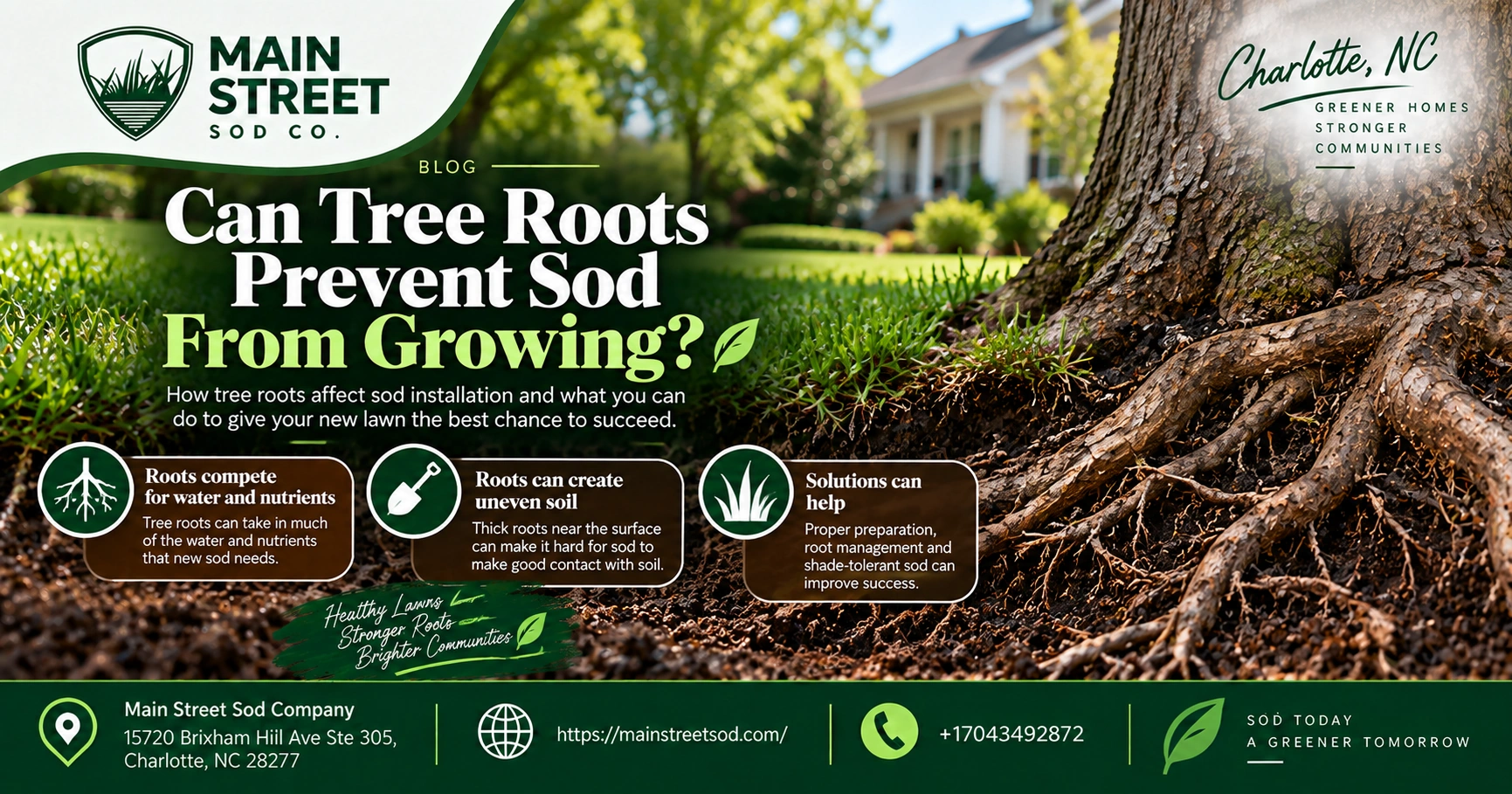
Roots compete with new grass
Tree roots and turf roots occupy some of the same soil.
Where the tree has a dense network of shallow roots, new grass has less room to establish and may face stronger competition for water and available nutrients.
This can be particularly challenging immediately after installation, when sod is developing its connection with the soil underneath.
Surface roots reduce usable growing space
Large visible roots can leave very little soil for turf.
Sod placed across an uneven network of exposed roots may not make consistent soil contact. Grass in those areas can dry or remain weak because its roots do not have enough suitable soil to grow into.
Do not treat cutting major roots as routine sod preparation. Significant root damage can affect the health and stability of a mature tree.
Shade limits photosynthesis
Even when soil conditions are good, grass still needs adequate light.
A mature canopy can filter sunlight for much of the day. If the selected turf requires more sun than the site receives, adding extra water or fertilizer will not correct the basic light limitation.
Roots and shade often create a combined problem
Imagine a section beneath a large tree that receives little direct sunlight and contains numerous shallow roots.
Choosing a grass with better shade tolerance may address the light issue, but it does not create more soil around those roots.
Likewise, improving the soil will not make the canopy allow more sunlight through.
This is why successful sod installation around mature trees requires evaluating the entire site rather than trying to solve one symptom.
How Can Soil Be Prepared Without Damaging Tree Roots?
Soil preparation around mature trees should be more conservative than preparation in an open lawn.
The goal is to create suitable sod-to-soil contact without unnecessarily disturbing important roots.
Start by identifying major surface roots
Before removing old grass or loosening soil, look closely at the tree’s root zone.
Large roots should be treated differently from ordinary compacted soil or small landscape debris.
Avoid aggressive digging, trenching, or mechanical cultivation across major roots merely to create a perfectly flat surface.
Work with the existing grade where possible
The surface around a mature tree may naturally be less uniform than the open lawn.
Minor imperfections are often preferable to significant root disturbance.
It is also important not to bury the tree’s trunk or root flare under a deep layer of new soil simply to create a level sod surface.
If making the lawn level would require major changes around the tree, reconsider whether that immediate area should contain turf.
Maintain good soil-to-sod contact
Where there is suitable soil between roots, preparation should provide a reasonably loose, clean growing surface.
Good contact between sod and soil helps new roots move into the ground instead of leaving air gaps beneath the turf.
Professional sod preparation can be especially helpful when the site includes mature trees because the preparation plan can account for both the turf and existing landscape conditions.
Do not solve tree-root problems by cutting first
A large root may seem inconvenient when preparing a lawn, but removing it can create a much bigger problem than an uneven section of grass.
When major roots are interfering with the planned installation, the safer decision may be to:
- Adjust the sod boundary
- Expand the non-turf area around the tree
- Work around the root
- Consult a qualified tree professional if significant root work is being considered
Protecting a mature tree should usually take priority over creating a few additional feet of turf.
What Grass Options Work Best Around Mature Trees?
There is no single best grass for every tree-covered yard.
The right choice depends primarily on sunlight, climate, soil conditions, moisture, and how much competition exists below ground.
Start with actual sunlight
Before selecting sod, observe the site at different times of day.
Ask:
- Does the area receive direct morning sun?
- Is it shaded only during the afternoon?
- Does filtered sunlight pass through the canopy?
- Is the area in deep shade for nearly the entire day?
“Under a tree” does not automatically mean “full shade.”
Two lawns with similar trees can receive very different amounts of light depending on canopy density, tree position, surrounding structures, and orientation.
Consider more shade-tolerant options
Fescue can be an option where partial shade is an important consideration, depending on the property’s climate and other growing conditions.
Some Zoysia varieties can also offer more shade flexibility than grasses that perform best in strong full sun.
However, shade tolerant does not mean shade proof.
Even turf that handles partial shade needs enough usable light to maintain healthy growth.
Be cautious with high-sun grasses
A grass that performs beautifully in the sunny portion of the yard may become sparse beneath a dense canopy.
That can create a frustrating cycle where homeowners repeatedly patch the same area even though the real problem is that the site does not meet the turf’s sunlight requirements.
Consider the whole property
Do not choose grass for one tree without thinking about the rest of the lawn.
The best turf selection should account for:
- Sun and shade patterns
- Summer heat
- Soil conditions
- Irrigation
- Traffic
- Maintenance preferences
- How much of the property is shaded
In some yards, the transition between lawn and tree bed may provide a better solution than trying to maintain turf all the way to the trunk.
Homeowners can review our service areas when planning sod projects in the communities Main Street Sod serves.
What Are the Alternatives for Areas With Deep Shade?
Sometimes the best answer is to stop replacing grass in a location that cannot reliably support it.
If several attempts at growing turf beneath the same mature tree have failed, look at the growing conditions before installing another layer of sod.
Expand the mulch bed
A larger mulch bed can create a clean, intentional transition between lawn and tree.
It also allows homeowners to avoid placing sod directly across exposed roots or in the darkest part of the canopy.
Keep mulch away from direct contact with the trunk instead of piling it into a mound around the base.
Use an appropriate shade-adapted ground cover
Some landscapes can accommodate plants or ground covers better suited to low-light conditions.
The appropriate option depends on climate, site conditions, maintenance expectations, and the surrounding landscape.
Create a defined non-turf area
Decorative landscape areas can sometimes make more sense beneath extremely mature trees than grass.
The objective is not necessarily to make every square foot of the property turf. A thoughtful boundary can make both the lawn and the tree look more intentional.
Keep turf where growing conditions improve
Sometimes grass struggles only within the innermost part of the canopy.
In that situation, a homeowner might maintain a larger bed immediately around the tree and begin the sod farther out where sunlight and soil conditions improve.
That gives the lawn a better chance of staying dense instead of creating a permanent thin spot at the center.
Choose the Site Before Choosing the Sod
Installing sod around a mature tree can work, but the tree’s existing environment should guide the project.
Look first at sunlight, surface roots, soil depth, moisture, and usable growing space.
If the tree provides partial shade while leaving adequate soil available, the right turf and careful preparation may produce a healthy transition between tree and lawn.
If large roots dominate the surface and the area receives deep shade throughout the day, sod may never perform as well as it does in the open parts of the yard. In that case, expanding a mulch bed or using another landscape treatment may save you from repeatedly replacing struggling grass.
If you are considering sod installation around mature trees, Main Street Sod can help evaluate the site, preparation requirements, and turf options before installation. A good lawn plan should work with the trees already on your property, not at their expense.
FAQs
Can you lay sod directly over tree roots?
Sod needs consistent contact with suitable soil to establish well. Large exposed tree roots can make that difficult, and simply covering important roots with soil and sod is not always appropriate for the tree. Where roots dominate the surface, changing the lawn boundary may be the better approach.
Will sod grow underneath a large tree?
It can if the area receives enough sunlight and has adequate soil, moisture, and root space. Sod is more likely to struggle beneath trees with very dense canopies and extensive shallow roots.
Should tree roots be removed before installing sod?
Major tree roots should not be cut simply to make sod installation easier. Root removal can injure the tree and may affect its health or stability. Work around significant roots or seek qualified tree advice when root modification is being considered.
What grass is best for shade under trees?
The answer depends on climate and how much light actually reaches the area. Fescue and some Zoysia options may provide more shade flexibility in appropriate conditions, but no turf performs well without enough usable sunlight.
Can I add topsoil over exposed tree roots before laying sod?
Adding a substantial layer of soil over roots or around the base of a mature tree can change conditions in the root zone and should not be treated as a universal solution. If significant soil addition would be necessary, consider adjusting the sod area or getting professional guidance first.
What should I do if grass repeatedly dies beneath the same tree?
Determine whether the limiting factor is shade, root competition, moisture, soil depth, or several of these issues together. If the site cannot realistically support healthy turf, expanding a mulch bed or using another suitable ground cover may make more sense than repeatedly replacing sod.