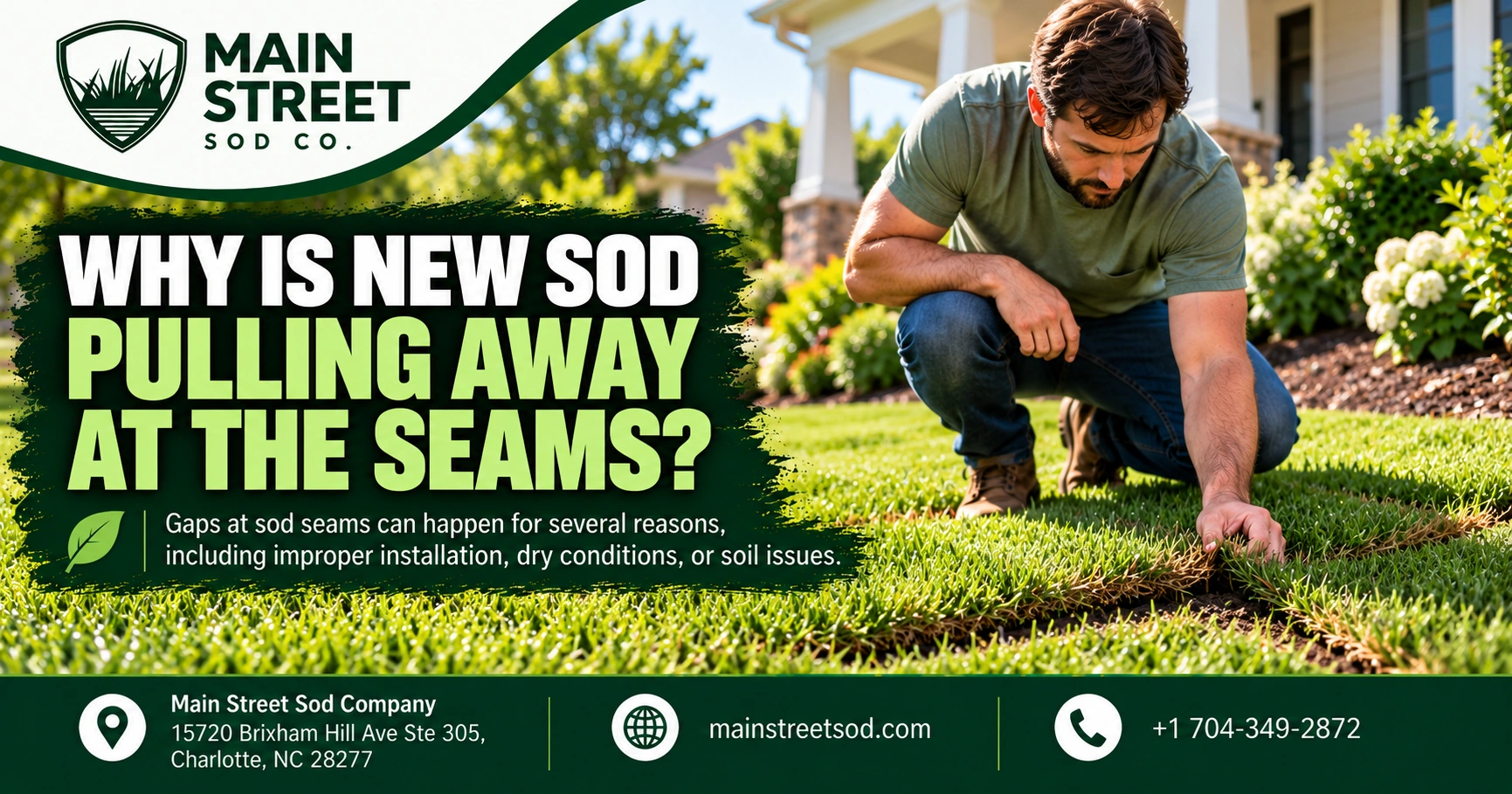
If new sod is pulling away at the seams, the most common causes are moisture loss, shrinkage, gaps left during installation, uneven soil underneath the turf, or poor contact between the sod and the prepared ground.
Fresh sod contains moisture when it is installed. If it dries faster than expected, the pieces can contract slightly and make seams more visible. Small gaps may also develop where rolls were not fitted tightly together or where the soil underneath contains dips, bumps, or air pockets.
A few narrow seams do not automatically mean the lawn has failed. The important question is whether the sod is still moist, rooting into the soil, and remaining stable. Gaps that continue widening, sections that stay loose, or seams associated with low spots and uneven ground may point to a larger installation or preparation issue.
Main Street Sod’s sod installation services include soil preparation, tight seam placement, and establishing good contact between sod and the ground below.
Why Is New Sod Pulling Away at the Seams?
Sod seams become more noticeable when individual pieces move or shrink after installation.
Fresh rolls should normally be placed tightly against neighboring pieces without overlapping or being stretched. Main Street Sod describes its installation process as placing sod so seams are tightly butted together and pressing the turf firmly against the prepared soil to reduce gaps and air pockets.
Problems can appear when that close fit changes after installation.
One common reason is drying. As sod loses moisture, the soil layer attached to the roots can contract, causing the edges of individual pieces to pull slightly away from one another.
Uneven ground can create another problem. If one section sits over a low spot while the neighboring piece rests on firmer soil, the two edges may no longer remain level or tightly aligned.
Poor soil contact can also leave the sod less stable while it is trying to root.
Look at the entire pattern before deciding what caused the gap. Narrow seams across an otherwise level lawn may point toward drying, while irregular separations accompanied by bumps, depressions, or loose areas may indicate preparation issues.
What Causes Sod Seams to Separate?
Several conditions can produce visible gaps between sod pieces.
Common causes include:
- Sod drying during establishment
- Pieces installed with small gaps from the beginning
- Sod being stretched during installation and later contracting
- Uneven or poorly prepared soil
- Air pockets beneath the turf
- Inconsistent watering between different parts of the lawn
- Movement before roots are established
- Erosion or soil settling beneath certain sections
Penn State Extension recommends fitting the ends and sides of sod strips as closely together as possible because spaces cause the turf to dry more quickly and slow the process of neighboring pieces knitting together.
Installation technique therefore matters.
Trying to stretch a roll across a space can create a temporary appearance of coverage, but the sod may shrink back as it dries. Iowa State Extension likewise warns that stretched sod can develop gaps as it loses moisture.
The better approach is to place pieces snugly from the start while allowing them to rest naturally on a smooth, prepared surface.
How Does Drying and Shrinkage Create Gaps?
Sod contains soil, roots, grass, and moisture when it arrives at the property.
As moisture is lost, the thin soil layer attached to the roots can contract. The sod itself may then become slightly smaller, making seams that were barely visible at installation more obvious.
This effect can become more pronounced during hot, sunny, windy weather or when irrigation coverage is inconsistent.
Main Street Sod recommends keeping new sod consistently moist during early establishment while avoiding permanently saturated soil. Weather, soil type, shade, drainage, turf variety, and sprinkler coverage can all change how quickly the lawn loses moisture.
Edges are particularly vulnerable because they are exposed from the side as well as the top.
Once a gap develops, exposed soil between the pieces can dry faster, which may increase moisture stress along both edges.
That is why early seam gaps should be monitored rather than ignored.
The solution is not necessarily to water the entire lawn more heavily. Check the actual moisture beneath the affected seams first. The problem may be localized sprinkler coverage rather than insufficient irrigation everywhere.
Can Uneven Soil Cause Sod Pieces to Pull Apart?
Yes.
Sod performs best when it rests evenly on a smooth prepared surface.
If the ground has high spots, low areas, ridges, depressions, construction debris, or irregular grading, individual pieces may not lie at the same elevation.
One piece might bridge a small depression while the neighboring roll rests firmly against the soil. As traffic, watering, and settling occur, those pieces can move differently.
Main Street Sod’s grading and leveling service specifically addresses bumps, dips, low spots, uneven terrain, drainage, and soil redistribution before new turf is installed.
A visually flat yard is not always properly graded.
The soil also needs to support appropriate water movement. A low spot may stay soft and saturated while an adjacent area dries normally. That difference can affect both rooting and the stability of the seams.
If seam separation repeatedly appears in the same uneven section of lawn, the problem may be below the sod rather than with the grass itself.
Homeowners dealing with noticeable dips, slopes, or unstable areas can review Main Street Sod’s grading and leveling services.
Does Poor Soil Contact Make Seam Problems Worse?
Yes.
Roots need direct contact with the soil beneath the sod to establish effectively.
A piece resting over an air pocket or depression has less contact with the ground and may dry faster or remain loose longer than nearby turf.
University of Minnesota Extension recommends rolling newly placed sod to improve root-to-soil contact. Penn State also recommends smoothing the finished lawn with a lightweight roller and filling small openings before establishment.
Good soil contact also helps stabilize neighboring pieces.
As roots begin growing downward, the sod becomes increasingly anchored and less likely to move under light foot traffic or ordinary watering.
If a seam separates and both sides lift easily, the issue may be more than simple surface shrinkage.
Check whether the sod is touching the soil evenly underneath.
Do not repeatedly lift healthy sod that has already begun rooting. A gentle check near the affected seam is enough to determine whether there is a noticeable void or loose section.
How Should Separated Sod Seams Be Corrected?
The correct response depends on how large the gap is and how recently the sod was installed.
If the sod was just laid and has not rooted, a misplaced piece may sometimes be repositioned so it fits snugly against the neighboring strip.
Penn State specifically advises against stretching sod to fill a gap. Instead, the entire piece should be moved so it fits tightly. For larger installation gaps, a properly cut scrap piece can be fitted into the open area.
For small cracks between otherwise stable pieces, soil can be added to reduce exposed edges and help prevent further drying.
University of Minnesota Extension also recommends filling cracks with soil to prevent edges from drying.
After correction, restore appropriate moisture and minimize unnecessary traffic over the affected area.
Do not repeatedly pull, slide, or stretch sod that has already begun establishing roots.
Once rooting is underway, excessive manipulation can cause more damage than the seam itself.
Can Gaps Between Sod Pieces Fill In Naturally?
Small gaps may become less noticeable as healthy turf establishes and grows, but homeowners should not depend on natural spreading to correct every seam.
How quickly a gap fills depends on the turf variety, growing season, moisture, sunlight, and size of the opening.
Some grasses spread laterally more aggressively than others, while other turf types recover more slowly.
More importantly, an open seam can dry out the edges before the grass has time to grow across it.
Penn State notes that spaces between strips dry quickly and slow the knitting together of adjacent sod.
That means prevention and early correction are usually more reliable than simply waiting.
A narrow seam in healthy, firmly rooted turf may eventually become visually insignificant.
A wide gap with dry edges or exposed soil deserves more attention.
If the gap is expanding rather than shrinking, investigate moisture, soil contact, and surface level instead of assuming growth will solve the problem.
When Is Additional Soil Needed Between Seams?
A small amount of soil can be useful when narrow openings have developed between pieces.
The goal is to cover exposed soil and reduce drying along the sod edges, not bury the grass.
University of Minnesota and Penn State both recommend using soil to fill small cracks or openings between sod pieces during establishment.
Use soil that is reasonably compatible with the surrounding lawn rather than creating a dramatically different layer.
Avoid piling soil heavily on top of the grass blades.
For larger spaces, simply adding a deep strip of loose soil may leave a visible weak point in the lawn. A properly sized piece of sod may be more appropriate.
Additional soil is also not a substitute for correcting an underlying depression.
If a seam sits several inches lower than surrounding turf or repeatedly settles after correction, the subgrade may need evaluation.
The goal is to restore an even, stable surface not just hide the visible opening.
How Can You Prevent Future Sod Gaps?
Prevention begins before the first roll is installed.
The soil should be smooth enough for each piece to make consistent contact and graded appropriately so water does not collect unpredictably.
Main Street Sod notes that uneven terrain, low spots, drainage conditions, and compaction can all affect how well new turf establishes.
During installation:
- Fit pieces tightly without overlapping them.
- Do not stretch sod to cover extra distance.
- Stagger seams rather than creating long continuous joints.
- Press or roll the turf into contact with the soil.
- Correct obvious dips or bumps before laying sod.
- Water promptly after installation.
After installation, monitor moisture across the entire lawn.
Pay particular attention to seams, slopes, edges near pavement, and areas between irrigation zones.
Keep unnecessary traffic off the lawn until rooting is underway.
A well-prepared base combined with consistent moisture gives neighboring pieces the best opportunity to root and knit together.
When Does Seam Separation Need Professional Attention?
A few narrow seams do not usually require major corrective work.
Professional evaluation becomes more useful when the pattern suggests something deeper than ordinary drying.
Consider having the lawn assessed when:
- Gaps continue becoming wider.
- Large sections remain loose after neighboring areas have rooted.
- Sod repeatedly settles into the same dips.
- Seams separate alongside obvious high or low spots.
- Water consistently collects beneath or beside the affected areas.
- The ground feels unstable or unusually soft.
- Soil is washing away beneath the sod.
- Several areas remain dry despite adequate irrigation.
- Significant portions of the lawn were installed with large gaps.
Main Street Sod notes that recurring low areas, standing water, significant elevation changes, unstable slopes, erosion, and persistent muddy areas can indicate conditions where grading, drainage, or site preparation should be evaluated.
If the problem is primarily the surface placement of the sod, correction may be relatively simple.
If the underlying soil is uneven or water movement is contributing, repairing only the visible seams may not prevent them from returning.
Main Street Sod serves homeowners throughout North and South Carolina, including Charlotte-area communities, Rock Hill, Fort Mill, York County, Indian Land, Lake Wylie, and surrounding areas. Homeowners can review our service areas to check local availability.
FAQs
Are small gaps between new sod pieces normal?
Very narrow seams can sometimes become more noticeable as new sod dries and begins establishing. However, pieces should initially be fitted tightly together. Growing gaps should be checked for moisture loss, poor soil contact, or uneven ground.
Should I stretch new sod to close a gap?
No. Penn State Extension specifically advises against stretching sod into an open space because stretched pieces can later move or shrink. Newly laid pieces should instead be repositioned to fit tightly, or a properly sized sod piece can be used for a larger opening.
Can I put topsoil between sod seams?
Small cracks can be filled with compatible soil to reduce exposed edges and moisture loss. Avoid burying the grass or using soil alone to disguise large gaps or underlying depressions.
Why are my sod gaps getting bigger?
Increasing gaps commonly suggest continued drying or shrinkage. They can also occur when pieces were stretched during installation, when the underlying ground settles unevenly, or when poor soil contact allows sections to move independently.
Will sod eventually grow together at the seams?
Healthy turf can gradually make narrow seams less visible as it establishes and grows, but the speed depends on grass type and growing conditions. Open spaces should still be addressed because exposed edges can dry more quickly and slow establishment.
What if sod seams separate only in one part of the yard?
A localized pattern may point to uneven watering, a low or high spot, poor soil contact, erosion, or inconsistent grading. Compare moisture and surface level in the affected area with healthy sections before assuming the entire lawn needs more water.
Does uneven grading need to be fixed before replacing sod?
If the underlying grade is contributing to settlement, poor drainage, or unstable turf, correcting the base first is usually more effective than repeatedly replacing sod over the same problem. Main Street Sod’s grading and leveling services address low spots, uneven surfaces, and water movement before sod installation.
When new sod is pulling away at the seams, start with the visible clues: moisture, gap width, soil contact, and surface level. Small openings can often be managed early, while recurring separation or obvious unevenness may indicate that the foundation beneath the sod needs attention.
Main Street Sod provides professional sod installation, preparation, and grading services throughout our service areas for homeowners who want the lawn placed on a stable, properly prepared surface.