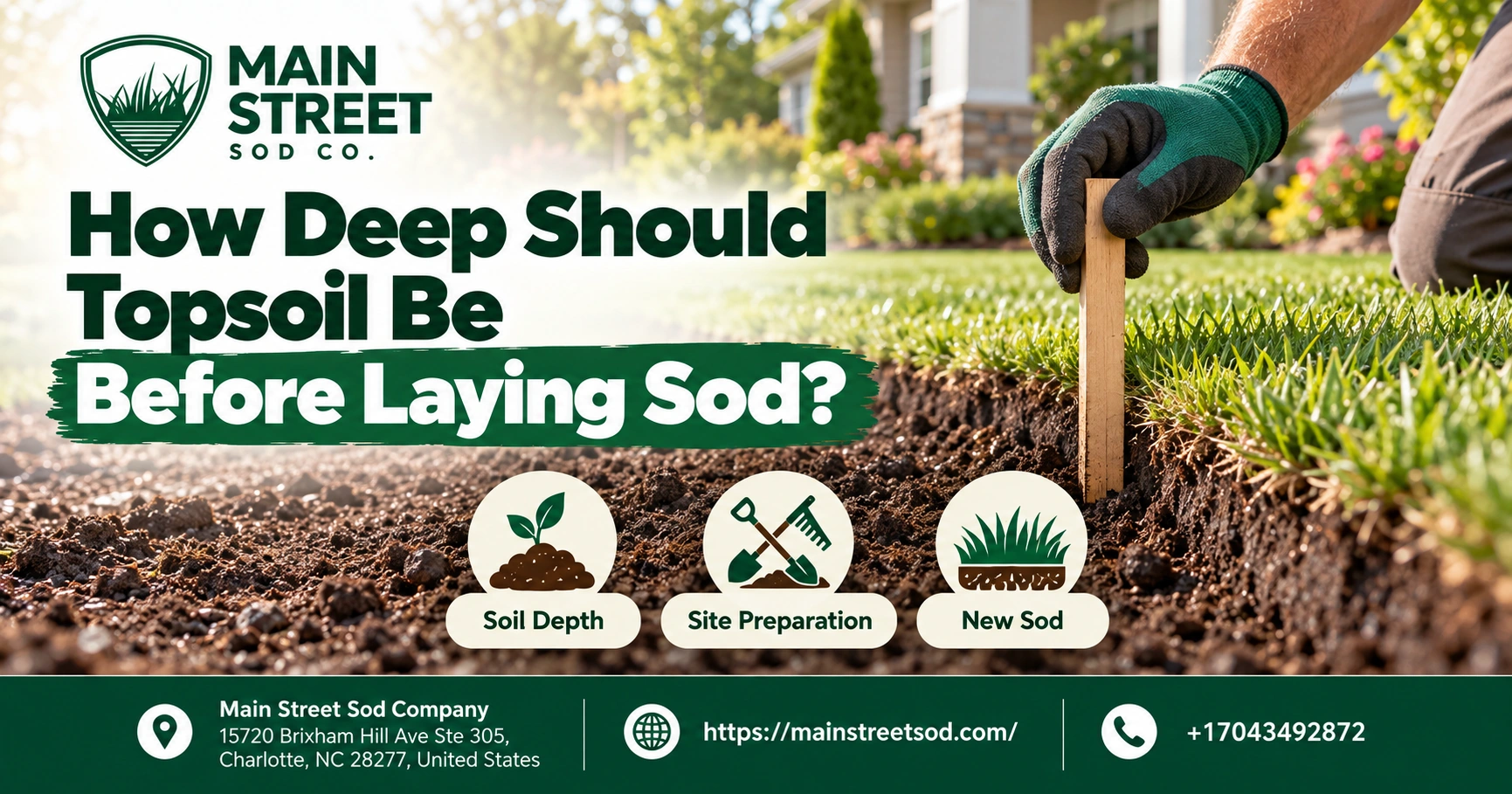
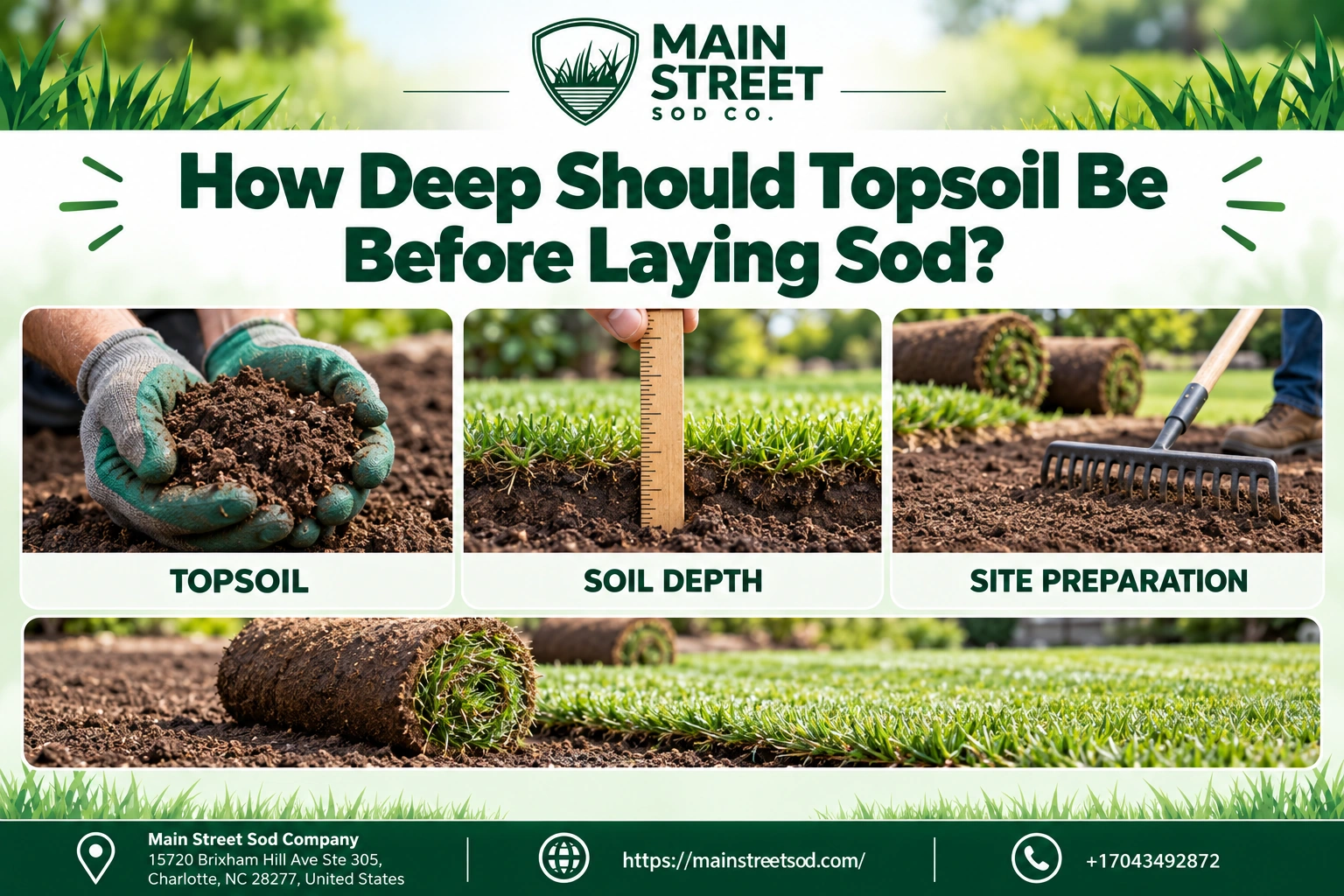
Topsoil should generally provide several inches of workable soil before laying sod, with about 4 to 6 inches commonly used as a practical target for a prepared lawn root zone. The exact amount depends on existing soil quality, compaction, drainage, grading, and the condition of the site.
New sod does not necessarily require 4 to 6 inches of newly imported topsoil. Existing suitable soil can contribute to the total root zone. The goal is enough quality, loosened soil beneath the sod for consistent rooting, moisture movement, and healthy establishment.
How Deep Should Topsoil Be Before Laying Sod?
A prepared root zone of roughly 4 to 6 inches is a useful general target for many residential sod installations. That does not mean every property needs 4 to 6 inches of new topsoil delivered.
Existing soil counts when it is suitable for root development.
If a property already has several inches of workable, reasonably fertile soil, preparation may involve loosening and grading that material instead of covering it with a deep layer of imported topsoil.
A site with compacted subsoil, construction fill, rocks, or very shallow usable soil may need additional material.
Is more topsoil always better?
No. Adding excessive soil can alter the final grade and create problems around sidewalks, driveways, patios, foundations, drainage structures, and irrigation components.
The important measurement is the usable root zone, not simply the depth of imported material.
Before ordering topsoil, evaluate what is already present. The objective is to give sod roots adequate prepared soil without unnecessarily raising the lawn or creating abrupt soil layers.
Why Does Topsoil Depth Matter for New Sod?
New sod arrives with roots contained within a relatively thin layer of soil. Those roots must begin growing into the prepared ground below for the lawn to establish.
Adequate soil depth gives roots room to expand.
A suitable root zone can also help with moisture storage, nutrient availability, and movement of water through the soil. These conditions become increasingly important as the sod develops beyond its initial establishment period.
Topsoil depth alone does not guarantee healthy grass.
Several inches of heavily compacted, poorly drained, or unsuitable soil may provide a weaker root environment than a properly prepared layer of quality existing soil.
This is why depth should be considered together with structure and drainage.
Sod should have consistent contact with the prepared surface, while the soil underneath should allow roots to penetrate rather than encounter an immediate hard layer.
Preparing adequate depth before installation supports a more stable transition from newly laid sod to an established lawn.
What Happens If the Soil Layer Is Too Shallow?
A shallow usable soil layer can restrict root development and make the lawn more dependent on moisture near the surface.
Roots may encounter compacted subsoil, rock, construction debris, or another restrictive layer shortly after leaving the sod.
Limited rooting depth can make moisture management more difficult.
A shallow root zone may dry more quickly during hot or dry conditions because less soil is available to hold usable moisture. Lawn performance may become less consistent across areas where soil depth varies.
Shallow soil can also expose differences in the underlying site.
One section may contain adequate native soil while another sits over compacted fill. The sod may initially look similar across both areas, but establishment can become uneven as roots develop.
Adding fertilizer or increasing irrigation does not necessarily correct inadequate soil depth.
The underlying restriction should be identified first. Depending on the condition, the solution may involve loosening existing soil, removing debris, adding suitable topsoil, or combining several preparation steps.
Do Different Lawn Conditions Require Different Soil Depths?
Yes. Existing site conditions affect how much soil preparation and additional topsoil may be appropriate.
A lawn renovation with healthy native soil may require little imported material. The existing soil can often be prepared, amended when necessary, and graded for installation.
New construction can be different.
Building activity may remove original topsoil or compact the remaining ground through equipment traffic. Fill material, stones, and construction debris can also reduce the amount of usable soil near the surface.
Sloped areas present another consideration.
Soil depth should support the lawn without creating grading conditions that encourage erosion or direct water toward structures.
Areas near mature trees require careful evaluation because major changes in soil depth around established root systems can create separate landscape concerns.
There is no single imported topsoil depth that fits every property.
Evaluate the current soil profile, final elevation, drainage, grass requirements, and site use before deciding how much material to add.
How Does Existing Soil Quality Affect Topsoil Needs?
Existing soil quality determines whether imported topsoil is necessary and how much preparation the site requires.
Good native soil may already provide much of the root zone needed for sod.
If that soil has reasonable structure, adequate depth, suitable drainage, and appropriate growing conditions, preparation may focus on loosening the surface and establishing the final grade.
Poor existing soil can require more work.
Heavy compaction can restrict rooting and water movement. Very sandy soil may behave differently with moisture. Rocky fill can interfere with grading and root development.
Soil testing can provide useful information about pH and nutrient conditions. Physical inspection is equally important because a laboratory test may not reveal compaction, buried debris, or shallow soil depth.
Do not judge soil quality only by color.
Dark soil is not automatically ideal, and lighter soil is not automatically unsuitable.
The important question is whether the existing material can support a stable, workable root zone after proper preparation.
How Can You Measure the Existing Soil Depth?
Checking soil depth before ordering topsoil can prevent unnecessary material costs and grading problems.
Start by examining several locations rather than one convenient spot.
Use a shovel, soil probe, or similar appropriate tool to inspect the soil profile. Look at how far workable soil extends before reaching compacted subsoil, rock, dense fill, or another noticeably restrictive layer.
Where should you check?
Test representative locations throughout the planned lawn.
Include high and low areas, sections near previous construction, visibly thin locations, and places where soil conditions appear different.
A property may have adequate soil on one side and shallow fill on another.
Record approximate depths so the preparation plan reflects those differences.
You are not simply measuring from the surface to the deepest soil you can reach. The useful measurement is the depth of soil that can reasonably function as part of the lawn’s root zone.
Multiple observations provide a better picture of actual conditions than a single measurement.
Should Compacted Soil Be Loosened Before Adding Topsoil?
Compacted soil should generally be addressed before simply covering it with new material.
Placing loose topsoil over a hard, compacted surface can create two distinct layers. Roots may establish within the upper material but encounter resistance when they reach the compacted soil underneath.
Water movement may also differ between those layers.
Preparing the existing surface can create a more continuous root zone and improve the transition between native soil and added material.
The appropriate method depends on site conditions.
Severe compaction may require more substantial preparation than lightly compressed lawn soil. Underground utilities, irrigation components, tree roots, and other site features should be considered before deeper soil work occurs.
Avoid working soil when conditions make it excessively wet and prone to further compaction.
After loosening, appropriate topsoil or amendments can be incorporated where necessary.
The goal is not simply to create a soft surface. It is to develop a stable root zone that supports sod after establishment.
How Does Drainage Affect Soil Preparation?
Drainage should be evaluated before sod is installed because adding topsoil can change how water moves across a property.
Low areas may collect irrigation or rainfall. Poorly graded surfaces can keep sections of sod excessively wet while other areas drain normally.
Adding topsoil without a grading plan may worsen these problems.
The soil itself also affects drainage.
Water moves differently through sandy, loamy, compacted, or clay-heavy conditions. Creating sharply different soil layers can sometimes affect how moisture moves through the root zone.
Watch how the site behaves after rainfall or irrigation.
Standing water, persistent soft areas, erosion channels, and rapid runoff can indicate conditions that deserve attention before sod covers the ground.
Drainage corrections may involve grading or other site-specific work rather than simply adding more topsoil.
A successful sod base should hold enough moisture for roots while still allowing excess water to move appropriately.
Topsoil depth and drainage therefore need to be planned together.
How Should the Final Grade Be Prepared Before Sod Installation?
The final grade should create a smooth, stable surface that allows sod to contact the soil consistently and supports appropriate drainage.
Remove rocks, debris, large clods, and other materials that prevent an even installation surface.
The grade should account for the thickness of the sod itself.
If soil is brought level with an adjacent sidewalk before sod is installed, the finished grass surface may end up noticeably higher than the pavement.
Similar planning is needed around driveways, patios, curbs, irrigation heads, drains, and other fixed features.
Should the soil be perfectly flat?
Not necessarily.
A lawn may require gentle slopes to direct water appropriately. The objective is a smooth final surface without unnecessary depressions, abrupt changes, or grading that sends water toward places where it should not collect.
Avoid leaving the prepared soil excessively loose.
The surface should be stable while remaining workable enough for root development.
Final grading is the opportunity to correct surface irregularities before sod makes them harder to address.
When Is Additional Topsoil Needed?
Additional topsoil is most useful when existing soil does not provide enough suitable material for the intended root zone.
This may occur after construction, excavation, severe erosion, or removal of poor existing material.
Topsoil can also help when portions of the lawn have inconsistent soil depth and need correction as part of an overall grading plan.
Before adding material, identify the actual limitation.
If the primary problem is compaction, loosening existing soil may be more important than covering it. If the issue is poor drainage, simply adding several inches of topsoil may not correct the underlying cause.
Imported material should also be appropriate for lawn use.
Topsoil varies considerably, so homeowners should consider texture, cleanliness, consistency, and compatibility with existing site conditions.
Calculate material requirements only after determining the needed depth and area.
This reduces waste and helps prevent excessive grade changes.
Additional topsoil should create a better root zone, not merely make the prepared lawn look deeper or darker.
FAQs
Is 2 inches of topsoil enough for sod?
Two inches of imported topsoil may be enough when suitable existing soil underneath contributes to the overall prepared root zone. Two inches placed directly over poor, compacted, or rocky subsoil may not provide adequate conditions by itself.
Do I need 4 to 6 inches of new topsoil before laying sod?
Not necessarily. The 4 to 6 inch guideline refers to a useful prepared root zone, which can include suitable existing soil. The amount of new topsoil needed depends on what is already present.
Can I lay sod directly over existing soil?
Yes, when the existing soil is suitable and properly prepared. The surface should support good sod contact, appropriate drainage, and root development. Compaction, debris, weeds, and grading problems should be addressed first.
Can I put topsoil over compacted ground?
Topsoil can be added, but simply covering severe compaction may leave a restrictive layer beneath the new material. Preparing or loosening the underlying soil first can create a more consistent root zone.
How do I calculate how much topsoil I need?
Measure the lawn area and determine the average additional depth required. Because site conditions vary, calculate material after inspecting existing soil depth and establishing the desired final grade.
Should topsoil be compacted before sod is installed?
The prepared surface should be stable and reasonably settled, but not heavily compacted. Excessive compaction can restrict rooting and water movement, while an extremely loose surface may settle unevenly after installation.
Start With the Right Foundation for New Sod
The amount of topsoil a lawn needs depends on what is already beneath the surface. At Main Street Sod Company, we focus on the complete installation environment rather than assuming every property requires the same amount of imported soil.
We can help customers evaluate the practical factors that affect new sod, including soil preparation, final grade, grass selection, and establishment needs. If you are preparing for a new lawn and are unsure whether your existing soil provides enough usable depth, we can help you determine what should be addressed before the sod is installed.
Key Takeaways
A prepared root zone of roughly 4 to 6 inches is a practical general target for new sod, but that does not mean every lawn needs that much imported topsoil. Existing suitable soil can contribute to the required depth. Soil quality, compaction, drainage, grading, and site history should determine how much additional material is needed. Shallow or restrictive soil can limit root development and moisture management. Before ordering topsoil, inspect several areas, address compaction and drainage, and establish the final grade so new sod has a stable foundation.